

Early intervention — proactive advising combined with semester-by-semester degree planning — is the single most effective way to keep at-risk college students on track and prevent the extra semesters that drain time, money, and motivation. The University of Southern California’s research on proactive advising, the University Innovation Alliance’s degree-map playbook, and a federal impact study from REL West all point to the same conclusion: the earlier you act, the fewer costly detours you will face.
Three mechanisms drive that benefit:
- Degree maps expose prerequisite chains and scheduling conflicts before they derail a semester.
- Proactive advisor outreach builds the self-efficacy students need to stay enrolled through hard stretches.
- What-if scenario planning lets students test a major change or course swap without accidentally adding a year.
Do this week: Pull your unofficial degree audit (most schools post it in the student portal), identify any prerequisites you haven’t started, and email your advisor to schedule a meeting before the add/drop deadline closes.
Key Takeaways
Early intervention through proactive advising and semester-by-semester degree planning is the most reliable way to prevent extended time-to-degree for at-risk college students.
| Point | Details |
|---|---|
| Act in the first term | Missing a gateway prerequisite in term 1 can push graduation back by one to two full semesters. |
| Degree maps reveal hidden traps | Semester-by-semester maps expose prerequisite chains and scheduling conflicts before they become crises. |
| Proactive advising boosts graduation odds | Prescriptive advising has a direct positive effect on four-year graduation rates, mediated by student self-efficacy. |
| Group workshops scale cost-effectively | Nudges plus group counseling workshops improve academic-plan completion at lower cost per outcome than one-on-one advising. |
| Univyze supports smarter planning | Univyze’s term-by-term dashboard, what-if scenarios, and AP/transfer credit tools help students spot conflicts early — verify all plans with your official degree audit and advisor. |
Table of Contents
- Why at-risk students need early intervention in the first term
- What the research actually shows about retention and graduation
- What happens when you wait too long
- Priority checklist for students and parents in the first four weeks
- How colleges can scale early intervention without hiring an army
- How degree-planning tools reduce your time-to-degree risk
- The planning problem nobody talks about enough
- Univyze gives you the map before you need it
- Sources
- FAQ
Why at-risk students need early intervention in the first term
“Early intervention” in a college context is not a counseling hotline or a remedial program. It is a set of proactive, structured services that catch planning problems before they become permanent delays.
The core components are:
- Proactive advising: Advisor-initiated contact, not just walk-in hours. The USC PASS model recommends a single assigned advisor, guided self-assessment, and documented follow-up at regular intervals.
- Semester-by-semester degree maps: A visual, term-by-term layout of every required course, with prerequisite chains marked. The University Innovation Alliance playbook describes mapping hundreds of majors so advisors and students can spot conflicts in advance.
- Course sequencing reviews: Checking that gateway courses (Calculus I, Chemistry, Writing) are taken early enough to unlock upper-division requirements on schedule.
- AP and transfer credit intake: Confirming which credits count, toward which requirements, before the first registration deadline.
- Schedule-conflict checks: Identifying time overlaps or section closures that would force a student to delay a required course.
- Mental-health referrals: Connecting students to counseling when academic stress signals a deeper issue. Students navigating testing accommodations for anxiety should loop in disability services early, since accommodation paperwork takes time.
Timing is everything. Research on course timing and time-to-degree shows that when a student takes a course, not just whether they take it, predicts on-time graduation. Miss Calculus I in the first term and you may push every downstream engineering course back by a full year.
What the research actually shows about retention and graduation
The evidence for early intervention is specific and consistent across study designs.
Proactive advising and self-efficacy (USC). Structured, advisor-initiated outreach builds academic self-efficacy — a student’s belief that they can handle the work — which in turn predicts retention and engagement. The USC proactive advising brief identifies guided self-assessment and collaborative goal-setting as the active ingredients, not just scheduling meetings.
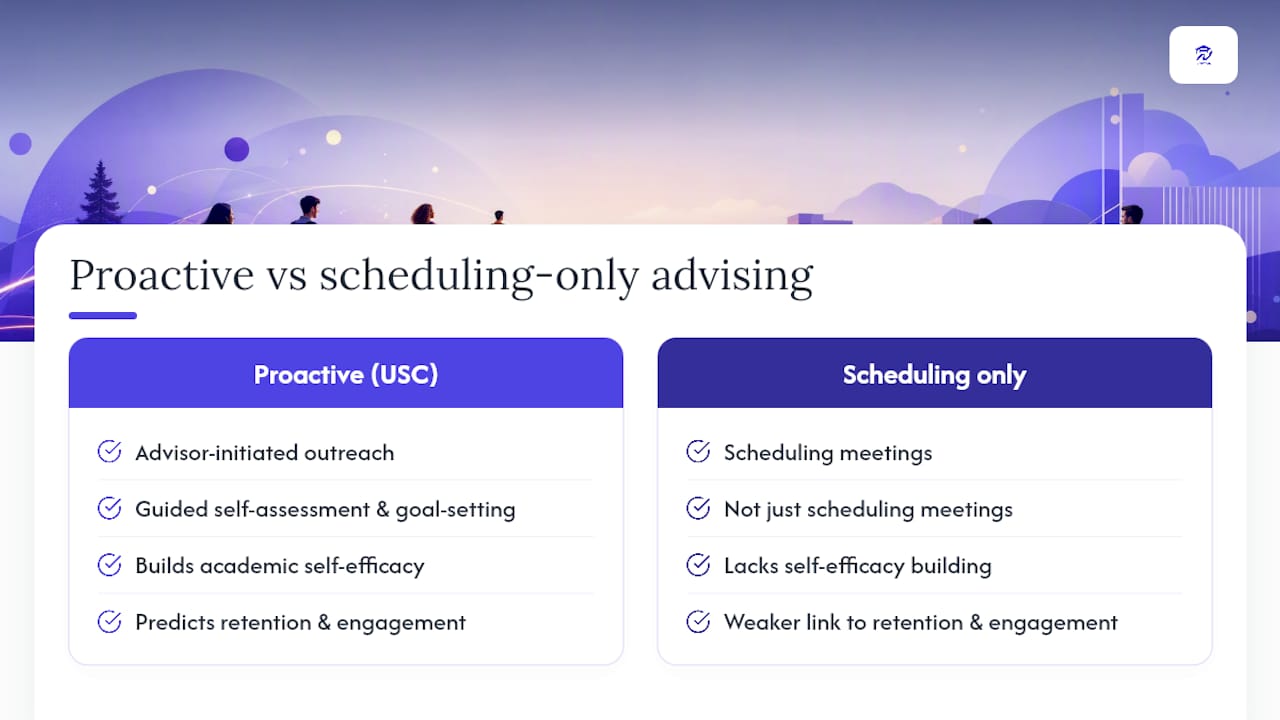
Prescriptive advising and graduation rates. A structural regression study found that prescriptive advising had a direct positive effect on four-year graduation probability, with additional indirect effects running through increased student self-efficacy and clearer academic goals. Advising style, in other words, is not a soft variable.
Degree maps and hidden hurdles (UIA). The UIA’s large-scale mapping project revealed that many majors contain hidden scheduling traps — courses offered only once a year, prerequisites that must be completed in a specific order — that students and even advisors miss without a visual map.
MAP intervention (REL West / IES). A federal impact study of the MAP system at Saddleback College found that combining targeted nudges, guaranteed counseling access, and online academic planning tools significantly increased academic-plan completion and counseling attendance compared to business as usual. Not every student responded, but the intervention moved the needle at the population level.
Statistic callout: A companion MDRC evaluation found that group counseling workshops with integrated nudges improved academic-plan completion more cost-effectively than one-on-one advising alone — a critical finding for resource-constrained institutions.
What happens when you wait too long
Delayed intervention has a compounding effect that most students underestimate until they’re already behind.
- Extra semesters: Missing one gateway prerequisite can push a student’s graduation date back by one to two full semesters, because upper-division courses that depend on it are often offered only once a year.
- Higher tuition costs: Each additional semester adds full tuition, fees, and living expenses — costs that are not recoverable.
- Disrupted transfer pathways: Transfer students who don’t confirm credit equivalencies early often discover that courses they completed don’t satisfy the requirements they expected, forcing retakes.
- Increased withdrawal risk: Students who feel lost in their degree path are more likely to stop out entirely, particularly after a failed registration attempt.
Research on curricular complexity shows that rigid prerequisite chains hit underrepresented students hardest, widening equity gaps over time.
Cost callout: A single extra semester at a mid-range public university typically adds $12,000–$25,000 in tuition and living costs. Two extra semesters can exceed the cost of a year of graduate school.
The emotional toll compounds the financial one. Students who spend multiple semesters feeling behind their peers report higher rates of anxiety and burnout, which further reduces the probability of completing the degree.
Priority checklist for students and parents in the first four weeks
Act in this order. Each step builds on the one before it.
- Pull your unofficial degree audit. Log into your student portal and download or screenshot your current degree audit. This is your baseline.
- Map your prerequisites. Identify every course your intended major requires and trace the prerequisite chains. Flag any gateway course you haven’t started. A degree requirement checklist can help you organize this.
- Confirm AP and transfer credits. Contact the registrar to verify which credits have been officially posted and which requirements they satisfy. Do not assume — get it in writing.
- Schedule an advisor meeting before add/drop closes. Bring your degree audit, your prerequisite map, and a list of questions. Ask specifically: “Am I on track for a four-year graduation? What is the earliest I need to take [gateway course]?”
- Build a tentative four-year schedule. Even a rough term-by-term plan reveals conflicts you won’t see by looking at one semester at a time. See the college schedule building checklist for a practical starting point.
- Register for gateway prerequisites first. If Calculus I, Chemistry, or a writing sequence is required for your major, it goes in your first or second semester — not “whenever it fits.”
Pro Tip: Before your advisor meeting, run a “what-if” scenario: ask yourself what happens to your plan if you switch your major or drop one course. Students who plan for major migration in advance face far fewer delays than those locked into a single path with no contingency.
How colleges can scale early intervention without hiring an army
Advisor-to-student ratios at many institutions make one-on-one outreach unsustainable at scale. The MAP model offers a cost-effective alternative.
- Identify high-risk cohorts early. Use registration data, GPA flags, and credit-load signals to target students who are most likely to fall behind. First-generation students, students carrying fewer than 12 credits, and students with unresolved transfer credits are high-priority groups.
- Deploy targeted nudges. Text and email reminders timed to registration deadlines and advising windows increase counseling attendance without requiring additional staff hours.
- Run guaranteed group workshops. The MDRC evaluation found group counseling workshops with nudges improved academic-plan completion at lower cost than one-on-one sessions. Guarantee a seat to every student in the target cohort.
- Integrate online degree-planning tools. Digital tools that let students build and update their own plans between advising appointments reduce the burden on advisors and keep students engaged between sessions. AI-enabled personalization tools can help advisors identify which students need the most urgent outreach.
- Assign a single advisor contact per student. Even when caseloads are high, a named point of contact improves follow-through. Students who know who to call are more likely to call.
- Track academic-plan completion and on-time registration as primary metrics. These are leading indicators of graduation outcomes and respond faster to intervention than GPA alone.
How degree-planning tools reduce your time-to-degree risk
The right planning tool does not replace your advisor. It makes every advising conversation more productive by giving you a clear picture before you walk in.
Features that matter most:
- Visual term-by-term degree maps that show prerequisite chains at a glance, so you can see which courses unlock which.
- What-if scenario planning to test a major change or minor addition without committing — and without accidentally blocking a required course.
- AP, dual enrollment, and transfer credit handling that maps your existing credits to specific requirements, not just a credit-hour total.
- Schedule-conflict detection that flags time overlaps before you submit your registration.
- Family dashboards that give parents a read-only view of progress, so they can support without micromanaging.
Here is how a typical sequencing fix works in practice: a student notices that Organic Chemistry II is only offered in the spring, but their current plan has it in the fall of junior year. They run a what-if scenario, shift the course, and discover that the change also requires moving a lab section. They bring the updated plan to their advisor, confirm it against the official degree audit, and register correctly — avoiding a one-semester delay they never would have caught otherwise.
Univyze is built around exactly this workflow. The student success dashboard integrates degree requirements with real course offerings so you can see conflicts before they happen. Students at UCLA, UCI, USC, and CSULB should always verify their plans against their official degree audit, university catalog, registrar, and advisor — Univyze is a planning tool, not an official audit system.
The planning problem nobody talks about enough
Most articles about college success focus on study habits or mental health. Those matter. But the students I see struggle most are not failing because they lack discipline — they’re failing because nobody showed them the full map.
A student can attend every class, pass every exam, and still graduate a year late because they took courses in the wrong order. That is a systems problem, not a personal failure. The research from USC, the UIA, and REL West all confirm it: the students who get a clear, semester-by-semester picture early are the ones who finish on time.
The uncomfortable truth is that most institutions still rely on students to seek out advising rather than pushing it to them. Until that changes structurally, students and parents have to be proactive themselves — which means pulling that degree audit, running the what-if scenarios, and not waiting until junior year to ask whether the plan actually works.
Always verify your plan with your official degree audit and advisor. No planning tool, including Univyze, substitutes for that confirmation.
Univyze gives you the map before you need it
Unclear degree plans are the most common reason students spend an extra semester — or two — in school. Univyze addresses that directly with automatic term-by-term planning, what-if major scenarios, AP and transfer credit intake, and schedule-conflict alerts, all in one dashboard.
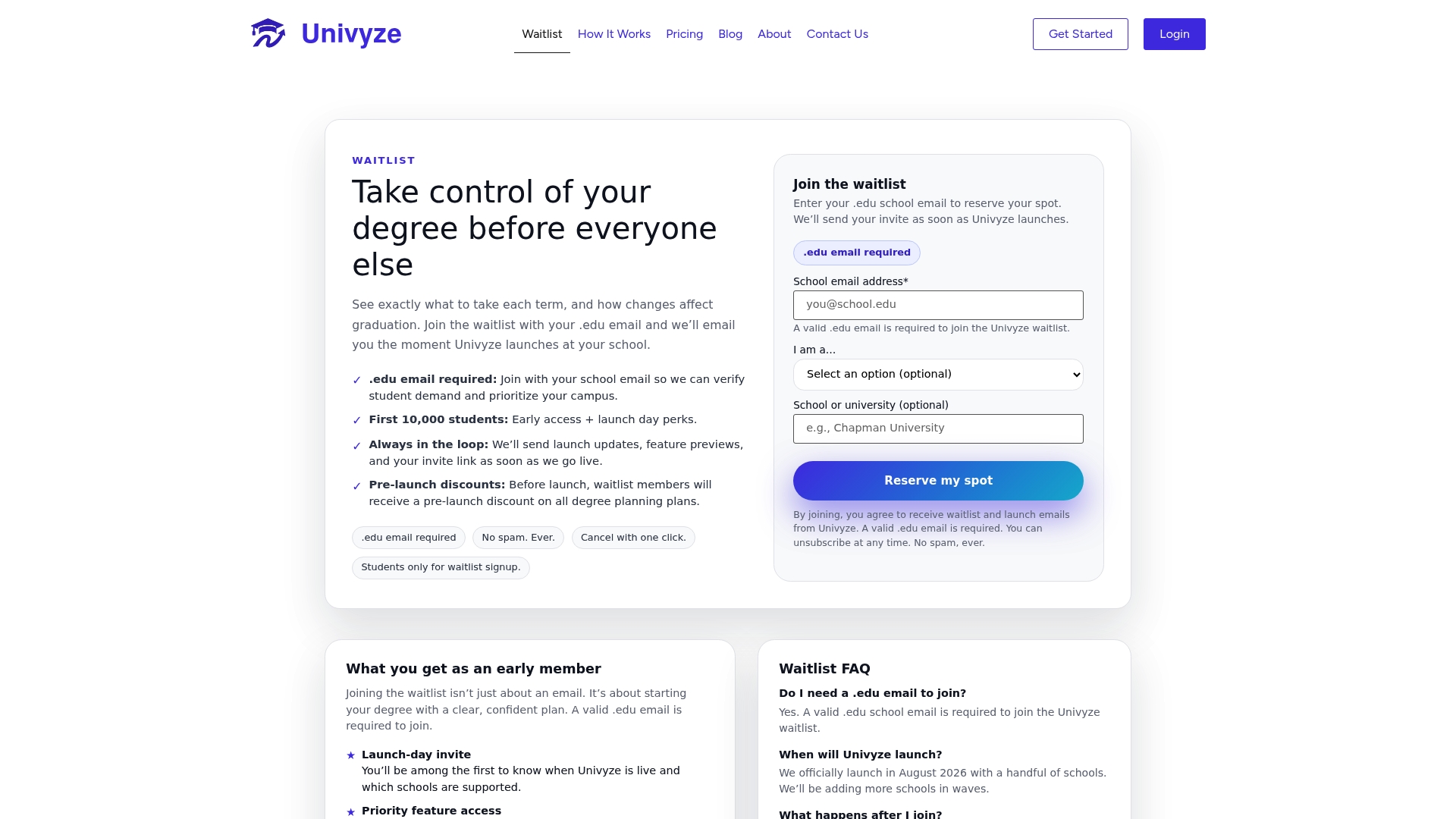
Parents get a shared visibility view so they can stay informed without hovering. Students get a clear picture of exactly where they stand and what comes next. Univyze is planning software, not an official degree audit — always confirm your requirements with your registrar and advisor.
Ready to see your path clearly? Join the Univyze waitlist and get early access to the tools that help you plan college classes that actually count.
Sources
- PROACTIVE ADVISING PRACTICE
- Proactive advising playbook (University Innovation Alliance)
- Impact study: MAP system (REL West / IES)
- MAP system evaluation (MDRC / REL West)
- Predicting 4-Year Graduation: Using Social Cognitive Career Theory to Model the Impact of Prescriptive Advising, Unit Load, and Students’ Self-Efficacy
- Analysis of course timing/ordering and time-to-degree (2019)
Always check your school’s current catalog, registrar pages, and official degree audit for program-specific rules — requirements change, and no external source replaces your institution’s official records. Students ready to build a clearer plan can join the Univyze waitlist.
FAQ
What does early intervention mean for college students?
Early intervention for college students means proactive advising, semester-by-semester degree mapping, and course sequencing reviews that begin in the first term — before missed prerequisites or scheduling conflicts cause delays.
Why do at-risk students need early help with degree planning?
How does proactive advising differ from standard advising?
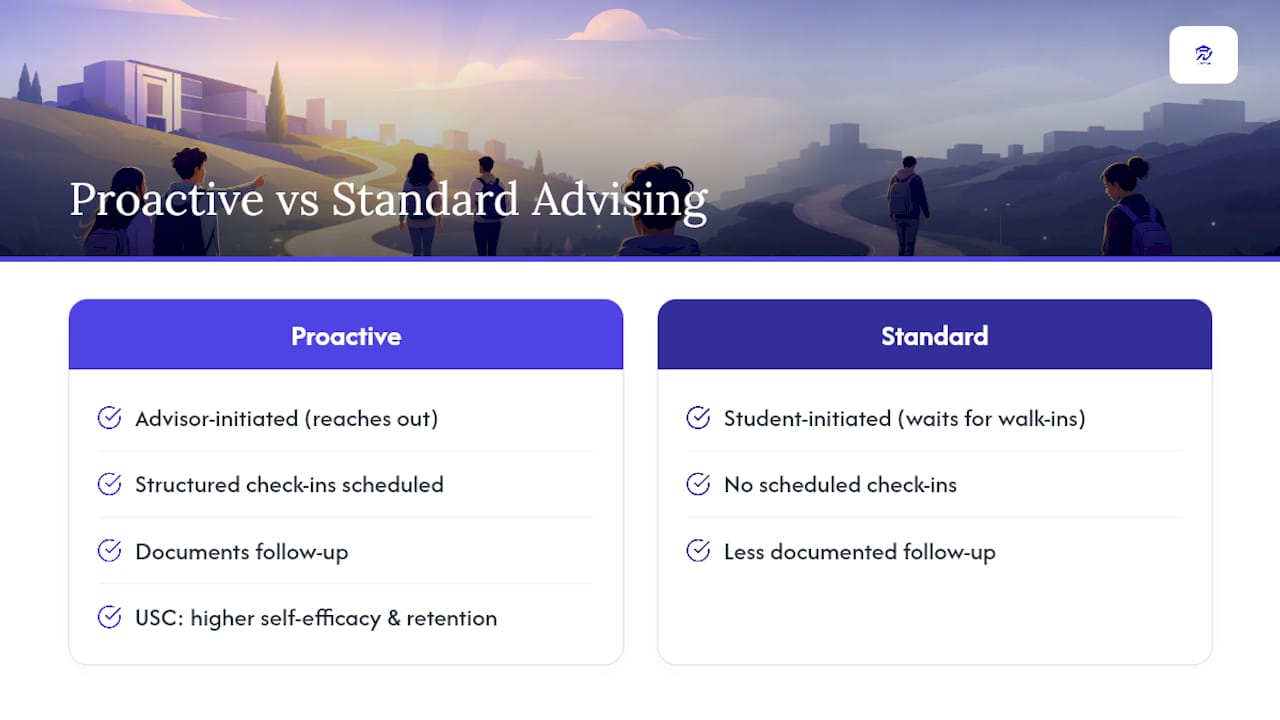
Proactive advising is advisor-initiated: the advisor reaches out, schedules structured check-ins, and documents follow-up rather than waiting for a student to walk in. USC research links this model to higher self-efficacy and retention.
Can a planning tool replace my academic advisor?
No. Tools like Univyze help you visualize your degree path, run what-if scenarios, and catch conflicts early, but your official degree audit, registrar, and advisor are the authoritative sources for your requirements.
What is the fastest action a student can take right now?
Pull your unofficial degree audit from your student portal, identify any unmet prerequisites for your major, and email your advisor to schedule a meeting before the add/drop deadline.