

Internships belong in your degree plan the same way required courses do: scheduled deliberately, documented carefully, and mapped against your graduation timeline before you commit. When you treat an internship as a planned, credit-bearing academic experience rather than a spontaneous résumé add-on, it does three concrete things for your degree:
- Transfers classroom learning into workplace skills through structured, applied practice
- Signals motivation and workplace readiness to employers, with applicants showing a higher probability of receiving an interview callback
- Counts toward degree requirements as a major requirement, elective credit, or experiential learning unit when arranged properly with your department
The single most important planning rule: treat every internship like a required course. This means advisor approval, a course code, and a slot in your term-by-term roadmap.
Table of Contents
- Why do internships matter for your academic progress and career?
- What types of internships can count toward your degree?
- When should you schedule internships across your four years?
- How do you earn official credit for an internship?
- How do you add an internship without delaying graduation?
- How do you maximize what you learn from an internship?
- What does the research say about internship outcomes?
- How does Univyze help you map internships into your degree plan?
- What should you do this week to lock in your internship plan?
- Key Takeaways
- The planning move most students skip
- Univyze makes internship planning visible for students and families
- Useful sources and further reading
- FAQ
Why do internships matter for your academic progress and career?
Internships are more than résumé builders. Research consistently links them to measurable academic spillovers: better retention, stronger course engagement, and improved degree completion rates, especially for students who are at risk of stopping out.
NACE defines internships as experiential learning that integrates classroom theory with workplace practice. That definition matters because it frames the internship as an academic event, not just a job. Three mechanisms explain why the effect is real:
- Experiential learning converts abstract course content into professional competence through cycles of action and reflection.
- Human capital development builds transferable skills — analytical thinking, communication, project management — that deepen your academic work.
- Employer signaling lets hiring managers infer your motivation and workplace navigation ability from a single line on your résumé, as Springer Nature research documents.
Paid interns averaged more job offers compared to unpaid interns, according to NACE research — a gap that reflects both the quality of paid placements and the equity advantages that come with compensation.
There is also a documented equity gap worth naming. Research describes a “Matthew Effect” in internship access: students with academic and socioeconomic advantages secure more internships, while those who would benefit most face the most barriers. Proactive planning and prioritizing paid opportunities are the practical responses.
What types of internships can count toward your degree?
Internships come in four main formats, and each interacts with degree requirements differently.
- For-credit (curricular) internships are formally enrolled courses. They carry a course code, appear on your transcript, and satisfy major, elective, or experiential learning requirements depending on your department.
- Co-op programs, as NACE describes, typically alternate full-time study with full-time paid work terms. Students gain a year or more of experience before graduation, often with formal credit attached.
- Non-credit (extracurricular) internships are not enrolled through the registrar. They build your résumé but do not reduce your credit requirements.
- Micro and remote internships are shorter, project-based engagements. Some departments accept them for independent study credit; most do not count them automatically.
Before you accept any offer, check these with your department:
- Does the internship qualify for a specific course code or independent study?
- Is there a credit limit on experiential learning units toward your degree?
- Does your major have a residency rule that limits how many credits can come from outside the classroom?
- What is the faculty pre-approval deadline, and is there an enrollment cutoff for the internship course?
Pro Tip: Start researching your department’s internship policies in the spring of your freshman year. Some majors require faculty pre-approval weeks before the internship starts, and missing that window means losing the credit entirely.
When should you schedule internships across your four years?
Start planning by sophomore year. That is the consensus from career services offices and the research on experiential learning outcomes. Waiting until junior year is not fatal, but it compresses your options and leaves less room to recover if something falls through.

| Year | Recommended action | Course-load implication |
|---|---|---|
| Freshman | Shadow, informational interviews, campus clubs | No load impact; use this time to research department policies |
| Sophomore | First internship (summer preferred); explore for-credit options | Summer internship avoids semester conflicts |
| Junior | Substantive internship (paid, for-credit if possible); co-op if your program supports it | Confirm prerequisites are met before semester internship |
| Senior | Capstone internship or second substantive placement; document for graduate school or job applications | Watch residency requirements; avoid overloading final semester |
Summer is the safest scheduling window because it adds experience without displacing required courses. A semester internship can work, but you need to verify that the courses you are skipping or deferring do not create a prerequisite chain problem the following term. Co-op models solve this by design: the alternating schedule is built into the program structure, so sequencing conflicts are managed at the program level.
How do you earn official credit for an internship?
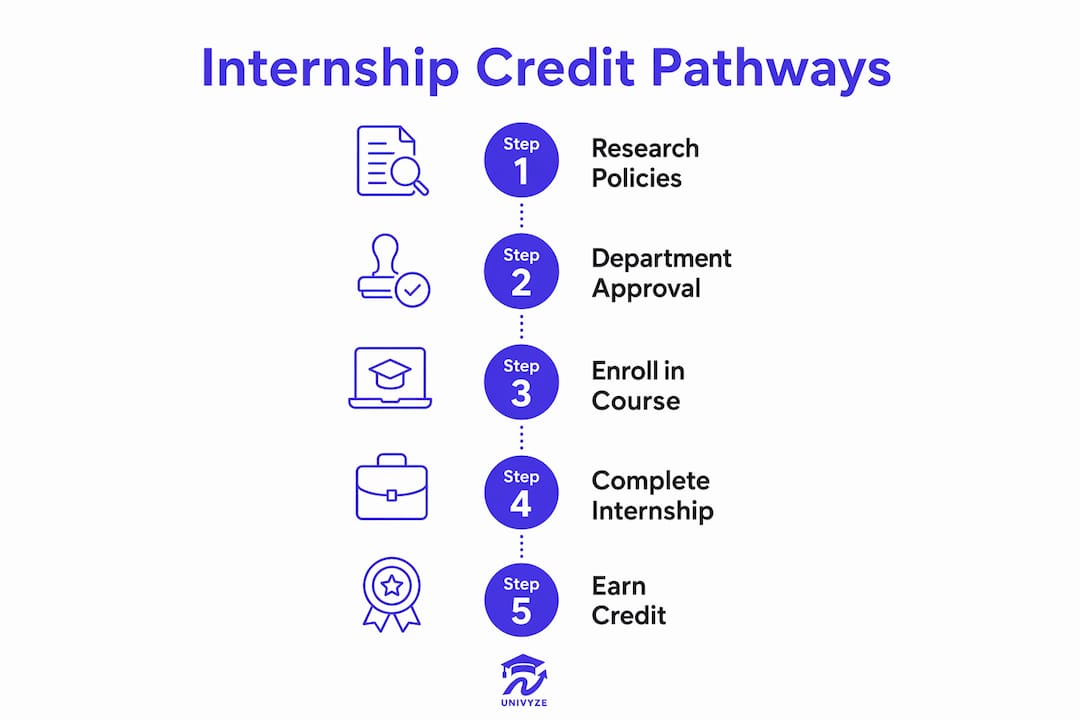
Credit is never automatic. You must enroll formally or get documented approval before the internship starts. Here is the process:
- Identify the course — ask your department for the internship course number or independent study option. Career services can also point you to centralized experiential learning courses.
- Meet with your faculty advisor — bring the internship job description and ask whether it qualifies for credit under your major requirements or as an elective.
- Complete a learning agreement — this document outlines your learning objectives, supervisor contact, credit hours, and evaluation criteria. It is the formal contract between you, your employer, and your department.
- Register for the course — submit the enrollment paperwork before the add/drop deadline. Late enrollment is rarely possible.
- File supervisor evaluations and final deliverables — most internship courses require a midterm check-in, a final supervisor evaluation, and a reflective paper or portfolio. Submit these to your department and confirm the registrar has recorded the credit.
Campus resources you need to involve: your academic advisor, the department internship coordinator, career services, and the registrar. Each plays a distinct role, and skipping any one of them is how students end up with an internship that never appears on their transcript.
How do you add an internship without delaying graduation?
With preplanning, you can add internships without extending your time to degree. The key is using summers and substitute electives strategically rather than displacing required courses during the semester.
| Risk | Prevention |
|---|---|
| Prerequisite chain broken by a deferred course | Map prerequisites two semesters ahead; confirm deferral is safe with your advisor |
| Internship credit rejected by department | Get written approval before the internship starts, not after |
| Overloaded semester when internship runs concurrently | Drop one elective; add it in summer or the following term |
| Registrar paperwork missed | Set calendar reminders for add/drop and grade submission deadlines |
Keep these documents in one place: your signed learning agreement, advisor email confirmations, the course enrollment confirmation, and the registrar’s credit-posting record. If a dispute arises later, these are your evidence.
Pro Tip: Maintain a buffer of one elective per year that you can defer without consequence. That single open slot gives you the flexibility to run a semester internship without forcing an overload or a late graduation.
Avoiding common graduation delays almost always comes down to this: knowing your prerequisite chains cold and never assuming a credit substitution will be approved without written confirmation.
How do you maximize what you learn from an internship?
Plan your deliverables before the internship starts, not after. The experiential learning framework is clear: structured reflection and concrete assessment are what convert tasks into documented competencies.
- Set three to five learning objectives at the start, tied to course outcomes or professional skills in your field.
- Request meaningful assignments — projects with deliverables, not just administrative support.
- Keep a work portfolio: save reports, code samples, presentations, or data analyses you produced.
- Gather written supervisor feedback at the midpoint and end; this feeds directly into your internship course grade and your future job applications.
- Write directed journal entries connecting what you did each week to your course learning objectives.
Pro Tip: Capture at least one concrete artifact per month — a slide deck, a written report, a process document. When you apply for jobs, these are the specifics that make your résumé stand out from candidates who list the same internship title but can’t show the work.
For job application strategy, the portfolio artifacts you collect during an internship are often more persuasive than the internship title itself.
What does the research say about internship outcomes?
The evidence is strong, and the mechanisms are well understood.
A randomized field experiment using 1,248 fictitious but realistic résumés found that applicants with internship experience had a 12.6% higher probability of receiving an interview callback. That is a causal estimate, not a correlation, which makes it one of the most reliable numbers in this literature.
On earnings, Strada’s analysis found paid internships linked to higher first-job earnings, greater career confidence, and a higher perceived value of education. A matched NCES analysis published in Research in Higher Education links paid internships to better earnings and college-level employment outcomes one and four years after graduation.
Two caveats matter. First, selection bias is real: students who get internships tend to have higher GPAs and stronger social networks to begin with. Second, the equity gap means these benefits are not equally distributed. Both points reinforce the same practical advice: plan early, prioritize paid placements, and document everything.
How does Univyze help you map internships into your degree plan?
Using a planning tool makes internships visible in your roadmap and prevents sequencing mistakes before they cost you a semester. Univyze’s degree-planning dashboard is built for exactly this kind of forward-looking scenario work.
Features that directly support internship planning:
- Term-by-term automatic planning shows you which semesters have room for an internship course without displacing required courses
- What-if scenario analysis lets you test credit substitutions before you commit — swap an elective for an internship course and see the downstream effect on your graduation timeline
- AP, dual enrollment, and transfer credit handling frees up elective slots that can absorb internship credit
- Summer session planning makes it easy to schedule internships in the lowest-risk window
- Shared family dashboards give parents visibility into how the internship fits the overall plan
| Univyze feature | How it helps with internships |
|---|---|
| What-if planning | Test credit substitution before advisor meeting |
| Term-by-term roadmap | Identify open elective slots for internship enrollment |
| Summer session view | Schedule internship without displacing required courses |
| Shared dashboard | Keep family informed of credit status and deadlines |
Pro Tip: Use Univyze to store advisor confirmation notes and registrar deadlines alongside your internship paperwork. Having everything in one place means you catch a missed deadline before it becomes a problem.
Always verify your degree requirements with your official degree audit, university catalog, registrar, and academic advisor. Univyze helps you track graduation progress and visualize your plan, but it does not replace official institutional records.
What should you do this week to lock in your internship plan?
Do these five actions now:
- Contact career services and ask for a list of for-credit internship options in your major and any employer partnerships your school maintains.
- Meet your academic advisor with a specific internship description in hand. Ask whether it qualifies for credit and what the enrollment deadline is.
- Request a learning agreement template from your department or career services so you know exactly what documentation is required.
- Check registrar deadlines for internship course enrollment, add/drop, and grade submission for the term you plan to intern.
- Update your degree map — in Univyze or on paper — to slot the internship course into your plan and confirm no prerequisite chain is disrupted.
For families: Ask your student’s advisor these three questions: Does this internship qualify for credit? What paperwork is required and when? Will this affect the graduation timeline? Keep copies of every approval email.
Key Takeaways
Internships boost learning, career signaling, and degree completion when planned as credit-bearing or scheduled academic experiences — not as spontaneous additions.
| Point | Details |
|---|---|
| Plan by sophomore year | Early planning captures summer opportunities and avoids prerequisite conflicts later. |
| Paid internships outperform unpaid | NACE data shows paid interns received more job offers than unpaid interns. |
| Credit requires formal enrollment | Approval and course registration must happen before the internship starts, not after. |
| Use summers to protect your timeline | Summer internships add experience without displacing required semester courses. |
| Univyze maps internships into your roadmap | What-if planning and term-by-term views help you slot internships without delaying graduation. |
The planning move most students skip
Most students treat an internship as something they figure out after registration closes. That is the wrong order. The students who get the most out of internships — academically and professionally — are the ones who walk into their advisor’s office with a specific opportunity already researched, a course code already identified, and a learning agreement template already downloaded.
The research on signaling is worth taking seriously here. Employers are not just reading your internship title; they are inferring whether you can navigate a professional environment, manage your own development, and follow through. A well-documented, credit-bearing internship with a portfolio of real deliverables tells that story far better than a vague line about “assisting with projects.”
Univyze helps you visualize your plan, but the planning itself is yours to own. Verify everything with your registrar and advisor. The tool helps you see the map; the official audit tells you whether you are actually on track.
Univyze makes internship planning visible for students and families
Slotting an internship into a four-year degree plan without disrupting your graduation timeline is a sequencing problem. Univyze solves it by showing your entire roadmap in one place, so you can see exactly where an internship course fits, what it replaces, and what happens to your graduation date if you make that swap.
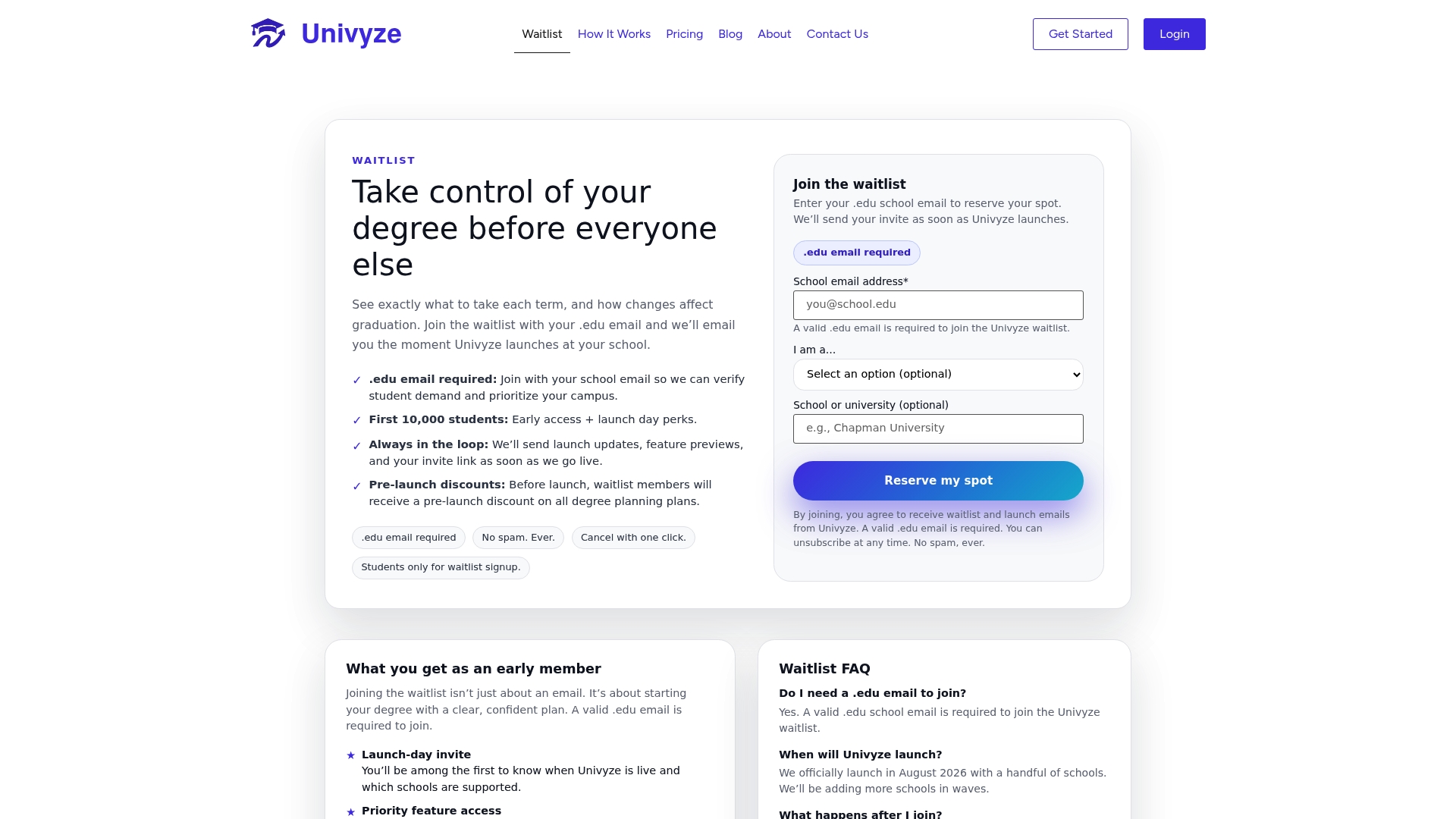
The features that matter most for internship planning: what-if scenario analysis for credit substitutions, automatic term-by-term scheduling, summer session visibility, and a shared dashboard so your family can see the plan too. You can build your term-by-term degree plan and test internship scenarios before your next advisor meeting.
Verify all credit and degree requirements with your official degree audit, registrar, and academic advisor. Univyze supports your planning; it does not replace institutional records.
Ready to map your internship into your degree plan? Join the Univyze waitlist and get early access to the full planning dashboard.
Useful sources and further reading
The sources below are the primary research and industry authorities behind this article. For institution-specific rules, consult your campus career services office, department internship coordinator, and registrar directly.
- NACE Internship Definition and Guidance — industry-standard definitions, paid vs. unpaid data, co-op frameworks
- Student Internships and Academic Spillovers — retention, graduation, and equity gap research
- Field Experiment on Internships and Interview Callbacks — causal evidence on the 12.6% callback advantage
- Strada: The Power of Work-Based Learning — earnings, confidence, and perceived education value
- Work-Based Learning and Early Career Outcomes, Research in Higher Education — matched NCES analysis on earnings one and four years post-graduation
- Internships as Signaling and Human Capital, Springer Nature — signaling theory and employer inference
- Towards a Pedagogy of Internships — academic framework for internship design and learning outcomes
- Experiential Learning and Academic Success, ASEE — structured reflection and assessment in engineering programs
FAQ
Do internships count as college credit?
They can, but only when you formally enroll in an internship course or get documented departmental approval before the internship begins. Credit is never automatic.
When is the best time to do an internship in college?
Sophomore summer is the most common recommendation. It gives you enough coursework to be useful to an employer while leaving junior and senior years for more substantive, paid placements.
How do paid and unpaid internships differ in career outcomes?
NACE research shows paid interns averaged 1.61 job offers versus 0.94 for unpaid interns, and Strada’s analysis links paid internships to higher first-job earnings and greater career confidence.
Can an internship delay my graduation?
It can, if you defer a required course without checking the prerequisite chain or miss the enrollment deadline for the internship course. Scheduling internships in summer and getting written advisor approval before you start prevents most delays.
What is a learning agreement and why do I need one?
A learning agreement is a formal document outlining your learning objectives, credit hours, supervisor contact, and evaluation criteria. Most departments require it to award credit, and it protects you if a dispute arises about whether the internship qualifies.