

Declaring a major is defined as the formal process of officially selecting your primary field of academic study at a college or university. This decision unlocks access to specialized upper-division courses, activates your degree requirement checklist, and sets the structure for every semester that follows. Most institutions require students to declare by the end of their sophomore year, though some competitive programs push that deadline to the fall of sophomore year. A bachelor’s degree typically requires 120 credits, with your major accounting for 30–60 of those credits. Understanding what does declaring a major mean gives you the power to plan your time, money, and coursework without wasting any of them.
What does declaring a major mean at most colleges?
Declaring a major is primarily an administrative step that unlocks access to upper-division courses and formal degree requirement tracking. It is not a lifelong commitment. You are telling your institution which graduation checklist to apply to your transcript, which advisor to assign you, and which restricted courses you can now register for.
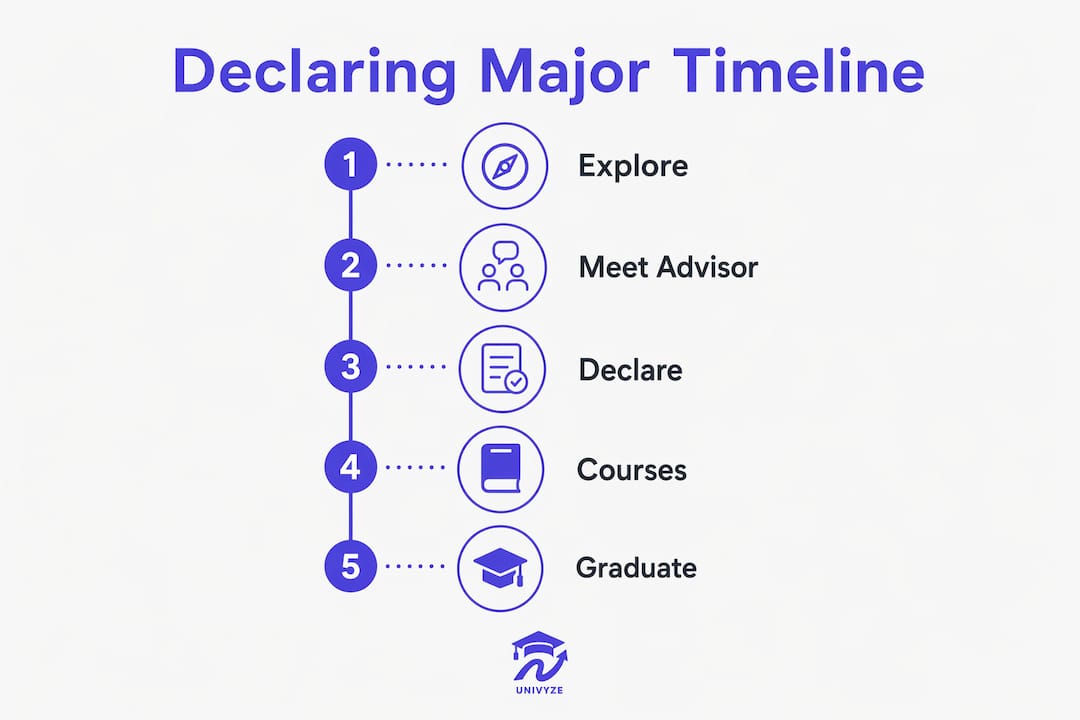
The process varies by school, but most colleges follow a similar sequence. You meet with an academic advisor, confirm any GPA or credit minimums, and submit a formal declaration form through your registrar or student portal. Some schools require a department signature or a brief application for competitive programs like nursing or engineering.
Common steps to declare a major include:
- Schedule a meeting with your current academic advisor or the department you want to join
- Review the major’s specific GPA and credit requirements before the meeting
- Complete the official declaration form through your registrar’s office or student portal
- Obtain any required faculty or department signatures for restricted programs
- Confirm your updated degree audit reflects the new major within a few days
Pro Tip: Meet with your intended department’s advisor before you officially declare. They can flag prerequisite gaps early and help you avoid taking courses that will not count toward your new degree plan.
Early exploration and advisor meetings lead to better-informed decisions at declaration time. Students who wait until the last minute often rush into a major that does not fit their actual goals.
When should you declare a major, and what happens if you wait?
The standard window for declaring a major falls between the end of freshman year and the end of sophomore year. Missing that window carries real academic and financial consequences.
Failing to declare by approximately 90 earned units triggers registration holds at many institutions. A registration hold blocks you from enrolling in new courses until you resolve the issue. That delay can push your graduation back by an entire semester, adding thousands of dollars in tuition and living costs.
The table below shows how deadline timing and consequences differ across institutional types:
| Institution type | Common declaration deadline | Consequence of missing deadline |
|---|---|---|
| Large public university | End of sophomore year (60 units) | Registration hold, limited course access |
| UC system schools | 90 units earned | Registration hold, enrollment blocked |
| Private liberal arts college | Beginning of junior year | Advisor flag, delayed upper-division access |
| Competitive professional program | Sophomore fall semester | Application required, enrollment waitlisted |
Most universities require formal declaration by junior year at the latest, and many enforce earlier deadlines for high-demand programs. The earlier you declare, the more flexibility you have to adjust your schedule without losing credits.
Pro Tip: Check your school’s specific declaration deadline in the academic catalog, not just the general advising website. Deadlines for competitive programs like business or engineering are often earlier than the general campus deadline.
Late declaration also creates a financial aid risk. Some scholarship and grant programs require you to be enrolled in a declared major. Staying undeclared past certain thresholds can affect your eligibility without any formal warning from your financial aid office.
How declaring a major shapes your course selection and academic plan
Declaring a major gives your course schedule a clear direction. Before you declare, you are essentially picking classes without a map. After you declare, every course you register for either counts toward your degree or it does not.

The credit structure makes this concrete. A standard bachelor’s degree requires 120 credits, and your major claims 30–60 of those credits. The remaining credits go toward general education requirements and electives. Without a declared major, students frequently fill elective slots with courses that satisfy nothing on their eventual degree checklist. This is called credit leakage.
Credit leakage occurs when students take courses outside their degree plan, extending enrollment and increasing total tuition costs. Declaring early prevents this by giving you a clear list of required courses to fill your schedule with purpose.
The planning benefits of declaring a major include:
- Access to upper-division and restricted courses that require major status to enroll
- A formal degree audit that tracks completed, in-progress, and remaining requirements
- Clearer multi-year scheduling that prevents last-minute scrambles for required courses
- Assignment to a dedicated departmental advisor who knows your program’s requirements
- Eligibility for major-specific scholarships, research opportunities, and internships
Understanding why majors have unit requirements helps you see the structure behind your degree. Each credit threshold exists to build skills progressively, so declaring early lets you start that progression on schedule rather than playing catch-up in junior year.
Efficient multi-year planning also means you can spot scheduling conflicts before they happen. If a required course only runs in the fall, you need to know that in your first year, not your third.
What does declaring a major mean for your career?
Declaring a major signals academic focus to employers and graduate programs, but it does not lock you into a single career path. This distinction matters. Students often delay declaring because they fear committing to one career forever. That fear is based on a misconception.
Only about 27% of graduates work in jobs directly related to their major. That figure shows that a major demonstrates your ability to master a complex subject, not a prediction of your exact job title. Employers in most fields care that you can think critically, meet deadlines, and complete a rigorous program of study.
That said, the choice of major still carries real weight. Academic advisors recommend balancing personal interest with market demand when selecting a major. Choosing purely on passion without considering job prospects increases the risk of underemployment after graduation.
Key points to keep in mind when thinking about major and career alignment:
- A major in a high-demand field like computer science or nursing provides a more direct path to employment, but it is not the only path to a good career
- Double majors and minors let you combine passion with practicality without abandoning either
- Internships, research positions, and extracurricular activities often matter as much as your major to employers
- Early declaration in competitive programs like engineering or business strengthens graduate school applications by showing clear academic intent
Changing your major is also a legitimate option. Most students who change majors do so before the end of sophomore year, which limits the credit damage. The key is to choose the right college major with enough information to make a confident decision, then revisit it if your goals shift.
Key Takeaways
Declaring a major is the single most consequential academic decision you make in your first two years of college, because it determines which courses count, which deadlines apply, and how efficiently you move toward graduation.
| Point | Details |
|---|---|
| Definition of declaring | Formally selecting your primary field of study to activate your degree checklist and course access. |
| Timing matters | Most schools require declaration by the end of sophomore year; missing deadlines triggers registration holds. |
| Credit leakage risk | Undeclared students often take courses that do not count toward their degree, adding cost and time. |
| Career flexibility | Only about 27% of graduates work directly in their major field, so your major signals ability, not destiny. |
| Plan early with tools | Using a degree planning tool like Univyze helps you map required courses before conflicts arise. |
Why I think students wait too long to declare
Students procrastinate on declaring a major for one main reason: they confuse choosing a major with choosing a career for life. I have seen this pattern repeat constantly. A student spends three semesters as “undeclared,” taking random electives, and then panics when a registration hold blocks them from enrolling in the courses they actually need.
The uncomfortable truth is that waiting does not give you more clarity. It just gives you fewer options. By the time you hit 90 units without a declared major, you are not exploring freely. You are scrambling. The students who declare early, even tentatively, end up with more room to change their minds because they have not already burned through their elective credits on courses that count toward nothing.
What actually builds clarity is structured exploration: meeting with advisors in two or three departments you are curious about, taking one or two introductory courses in those fields, and using a planning tool to see what each path looks like in terms of required courses and timelines. That process takes a semester, not three years.
The other mistake I see is treating the major as the only variable. Your internships, research experience, and the skills you build outside the classroom often matter more to employers than your specific major. Declare something that genuinely interests you and that has reasonable market demand. Then go build experience in that field. That combination beats staying undeclared every time.
— Ryan
How Univyze helps you plan your major declaration
Figuring out which courses count, when to declare, and how to sequence four years of requirements is genuinely hard without a clear visual. Univyze gives students a dynamic dashboard that maps degree requirements against real course offerings, term by term.
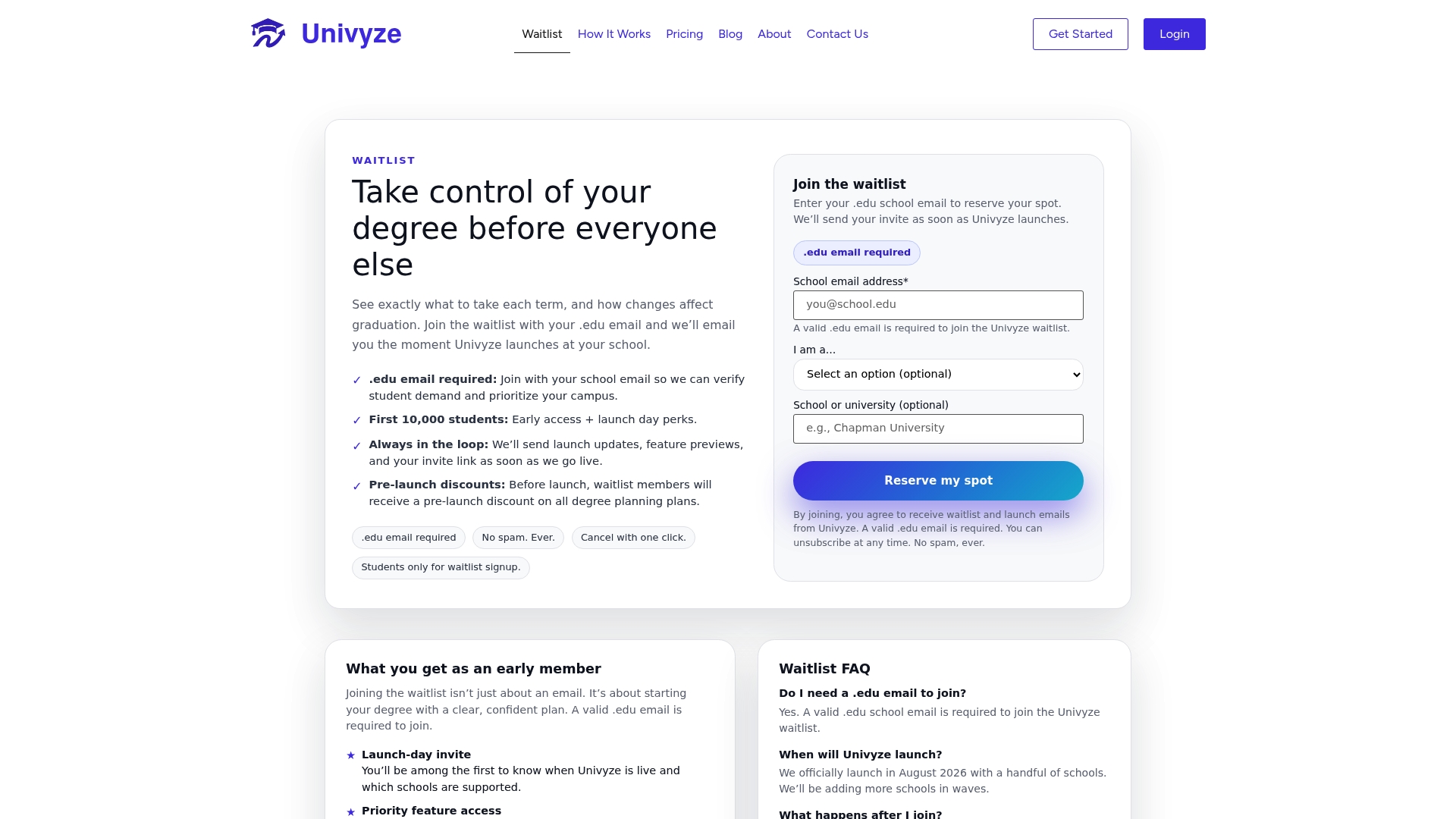
With Univyze, you can see exactly which courses satisfy your major, general education, and elective requirements before you register. The term-by-term degree plan feature lets you model what your path looks like if you declare now versus next semester, so you can make that decision with real information. Univyze also supports AP credits, dual enrollment, transfer credits, and summer sessions, so your full academic history is reflected in your plan. Join the Univyze waitlist and start building a degree plan that actually makes sense.
FAQ
What is a declared major in college?
A declared major is the official academic concentration a student has formally registered with their institution. It activates a specific degree checklist and grants access to upper-division courses in that field.
When do you have to declare a major?
Most colleges require declaration by the end of sophomore year or after earning roughly 60 units. Some competitive programs set earlier deadlines, and missing them can trigger registration holds.
Can you change your major after declaring?
Yes. Students can change their major at most institutions by meeting with an advisor and submitting a new declaration form. Changing before junior year typically limits the number of credits that do not transfer to the new degree plan.
Does your major determine your career?
Not directly. Only about 27% of graduates work in a role directly tied to their major. A major signals subject mastery and academic discipline, not a fixed career destination.
What happens if you never declare a major?
Failing to declare by your school’s deadline typically results in a registration hold that blocks future course enrollment. Staying undeclared also increases the risk of credit leakage, which extends your time to graduation and raises your total tuition cost.