

Choosing a college major as a freshman is a process of informed self-reflection combined with strategic exploration. Most colleges require major declaration by the end of sophomore year, after completing 60–64 credits. That deadline is closer than it feels on day one. Between 20% and 70% of students enter college undecided, which means you are far from alone. The good news: starting undeclared does not hurt your graduation timeline if you use your first two years with purpose. This guide walks you through the deadlines, the self-assessment frameworks, and the practical steps that keep you on track and out of extra tuition territory.
What deadlines and policies define when to declare your major?
Most colleges require declaration by the end of sophomore year, typically after completing 60–64 credits. Missing that window creates real consequences. Schools commonly place enrollment holds on students who have not declared, which blocks registration for the next semester. Some students also lose financial aid eligibility when they exceed credit thresholds without a declared program.
Declaration timelines are not uniform across all programs. Cornell University requires declaration before junior year. UC Santa Cruz mandates earlier declaration for transfer students. Specialized technical programs like engineering and nursing often require declaration in the first year because their course sequences are linear and rigid. Missing an early deadline in those fields can push graduation back by a full year.
Here is what every freshman should do before the end of their first semester:
- Check your school’s official catalog for the exact declaration deadline tied to your credit count.
- Confirm financial aid rules with the financial aid office, since aid packages sometimes require declared status after a set number of credits.
- Schedule an advising appointment in your first semester, not your second. Advisors flag holds before they happen.
- Log into your student portal and locate the major declaration form now, so you know the process before the deadline pressure hits.
Pro Tip: Set a calendar reminder for the end of your fourth semester. That is the latest most schools allow undeclared status without academic consequences.
The financial cost of missing deadlines compounds fast. An enrollment hold that delays one semester adds tuition, housing, and opportunity costs that can reach tens of thousands of dollars.
How do you assess your interests, aptitude, and career opportunities?
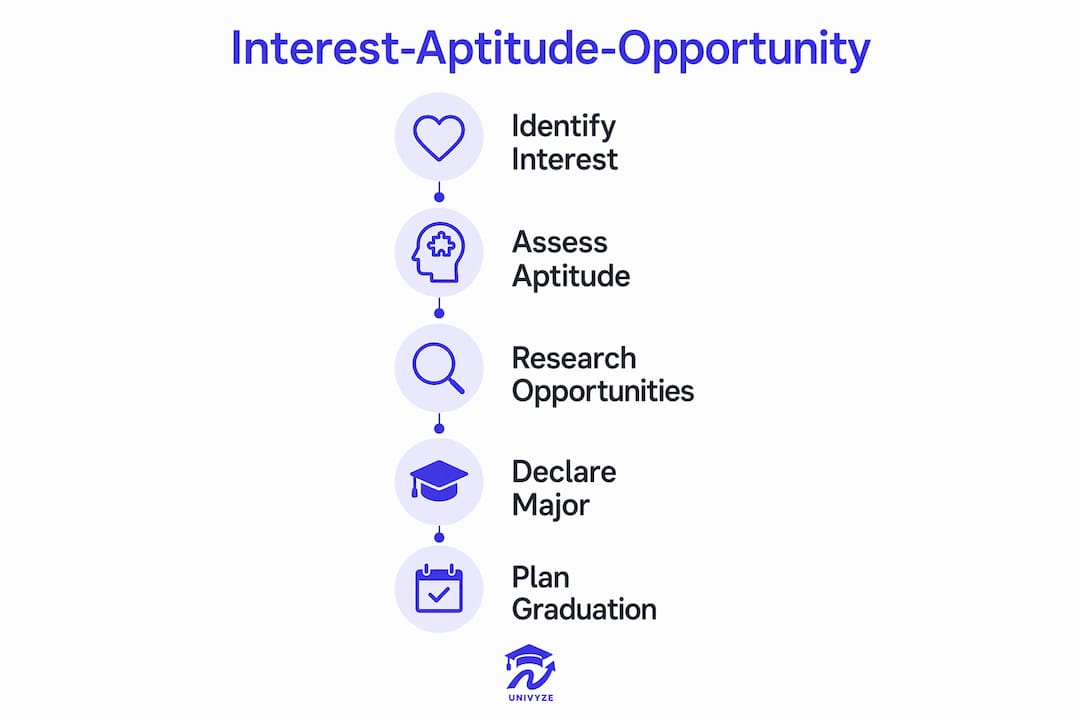
The most reliable framework for deciding on a college major is the Interest-Aptitude-Opportunity triad. Passion alone or salary alone leads to burnout or dissatisfaction. Combining all three factors produces the best outcomes for degree completion and career satisfaction.
Step 1: Identify your interest band
Federal career data organizes work into six broad categories: STEM, Health, Business, Humanities, Social Studies, and Trades. Students can identify their interest band in as little as 15 minutes by tracking what they read voluntarily. That is a meaningful signal. If you spend free time reading about psychology research, that points toward Social Studies or Health. If you gravitate toward code tutorials or math puzzles, STEM is a natural fit.
Step 2: Assess your aptitude honestly
Aptitude is not just what you enjoy. It is what you do well with reasonable effort. Review your strongest high school subjects and your performance in any dual enrollment or AP courses. A student who loves biology but consistently struggles with chemistry faces a real obstacle in pre-med tracks. Honest self-assessment here saves years of frustration.

Step 3: Research the opportunity landscape
Students who pick a major aligned with their interests complete degrees faster and at higher rates than those who choose based on salary alone. That said, ignoring the job market entirely is a mistake. Use the Bureau of Labor Statistics Occupational Outlook Handbook to check 10-year job growth projections and median wages for careers tied to your top major options. Then cross-reference those careers with the programs your college actually offers.
| Factor | What to assess | Where to find data |
|---|---|---|
| Interest | Voluntary reading and activity preferences | Self-reflection, interest inventories |
| Aptitude | Prior coursework performance and strengths | Transcripts, AP/dual enrollment results |
| Opportunity | Job growth projections and median wages | BLS Occupational Outlook Handbook |
| Program fit | Courses, faculty, and internship access | College catalog, department websites |
Pro Tip: Talk to a junior or senior in your top two major choices before you declare. Ask them what surprised them about the curriculum. Their answer will tell you more than any brochure.
How can you use your first two years to explore majors without losing time?
Starting undeclared is not a setback. Undecided students graduate in the same typical four years as declared peers when they use their first two years to complete general education requirements strategically. The key word is strategically.
General education courses are not filler. They are structured exposure to disciplines you may never have studied formally. A student who takes an introductory economics course to satisfy a social science requirement might discover a genuine interest in behavioral economics. That discovery costs nothing extra because the course counted toward graduation regardless.
Treat your first two years as a paid research period. Every general education course is a low-stakes test of a potential major. Use open electives to go one level deeper in any subject that surprises you.
The cultural anxiety over declaring early is often misplaced. Strategic delay allows better-informed, less costly decisions. The students who pay extra semesters are usually those who declared too early, chose the wrong major, and had to restart prerequisites from scratch.
A few tactics that keep exploration from turning into delay:
- Complete math and writing requirements early. These prerequisites feed into almost every major and are never wasted credits.
- Take one course per semester outside your assumed interest area. One unexpected elective per term adds up to eight new disciplines explored by the end of sophomore year.
- Track which courses you attend eagerly versus which ones feel like obligations. That pattern is data about your real interests.
- Avoid stacking too many exploratory courses in one semester. Spreading them out keeps your GPA stable while you figure out your direction.
The exception to flexible exploration is rigid, linear programs. Engineering and nursing majors require early declaration because missing a first-year prerequisite delays every subsequent course in the sequence. If you are leaning toward one of these fields, declare early and confirm the sequence with your advisor immediately.
Pro Tip: Use your college’s freshman course planning checklist to map which general education courses double as prerequisites for your top major options. Overlap is your best friend.
What practical steps lead to a confident major decision?
Deciding on a college major becomes much clearer when you gather real-world information rather than relying on assumptions. These steps move you from guessing to knowing.
-
Interview professionals in your target fields. Talking directly to workers gives you unfiltered insight into daily realities that career services brochures never include. Ask about the least enjoyable parts of their job. The answer is more useful than the highlights.
-
Read full program curricula, not just major titles. Two schools can both offer a “Communications” major with completely different course requirements. One might emphasize journalism and media law. Another might focus on digital marketing and analytics. The title means less than the actual course list.
-
Explore interdisciplinary and hybrid majors. If your interests span two areas, many universities offer combined programs. Data Science, Cognitive Science, and Environmental Policy are examples of fields that blend STEM with Humanities or Social Studies. These programs often produce graduates with rare skill combinations that employers value.
-
Evaluate faculty qualifications and research opportunities. A department with active research programs and industry connections gives you internship pipelines and recommendation letters that matter when you graduate. Check faculty bios and recent publications before committing to a program.
-
Build a pros and cons list for your top three options. Include career options, average starting salaries, program length, required courses you genuinely want to take, and courses you dread. Weight the list by what matters most to you.
-
Understand your school’s major change policy before you declare. Some schools allow free major changes within the same college. Switching between colleges within a university sometimes requires reapplication and credit re-evaluation. Knowing this in advance prevents expensive surprises.
The broader point worth holding onto: only 27% of graduates work in jobs directly related to their major. That statistic does not mean your major is irrelevant. It means your major builds transferable skills, and the specific field you enter often depends on experience, networking, and adaptability as much as your degree title. Choose a major that builds skills you want, in a subject you can sustain for four years.
Reviewing common graduation mistakes before you declare also helps. Students who understand the credit traps and policy gaps ahead of time make cleaner decisions.
Key Takeaways
Freshmen who declare a major using the Interest-Aptitude-Opportunity framework, meet institutional deadlines, and use general education courses for structured exploration graduate on time and avoid costly credit restarts.
| Point | Details |
|---|---|
| Declaration deadlines are real | Most schools require a declared major after 60–64 credits; missing this triggers enrollment holds or financial aid loss. |
| Use the triad framework | Assess interest, aptitude, and job market opportunity together. Passion or salary alone produces poor outcomes. |
| Undeclared is not behind | Undecided students graduate in four years when they complete general education and prerequisites strategically. |
| Linear programs require early action | Engineering and nursing have rigid sequences. Declare early in these fields or risk adding a full year. |
| Major does not lock your career | Only 27% of graduates work in a field directly tied to their major. Skills and adaptability matter more than the title. |
The myth I wish someone had debunked for me on day one
The biggest lie told to freshmen is that your major is your destiny. I have watched students pick majors they hated because the career sounded impressive, and I have watched others change majors three times chasing a passion without any plan. Both paths cost money and time.
What actually works is treating the first two years as a structured experiment. You are not committing to a career. You are testing hypotheses about yourself. The student who takes an intro philosophy course on a whim and discovers a love for logic and argumentation is not wasting time. That student is gathering data.
The anxiety around declaring early is real, but it is often misdirected. The students who end up paying for extra semesters are rarely the ones who took their time deciding. They are the ones who declared quickly, realized it was wrong, and had to rebuild their course plan from scratch. Strategic patience is not the same as procrastination.
One thing I consistently recommend: use every tool available to visualize your path before you commit. Univyze exists precisely for this. Seeing your degree requirements mapped against real course offerings, with your AP credits and transfer credits already factored in, changes how you think about your options. You stop guessing and start planning. That shift is worth more than any single piece of major advice.
— Ryan
How Univyze supports your major planning from day one
Picking a major is only the first step. Knowing whether your current course plan actually gets you to graduation on time is the harder question.
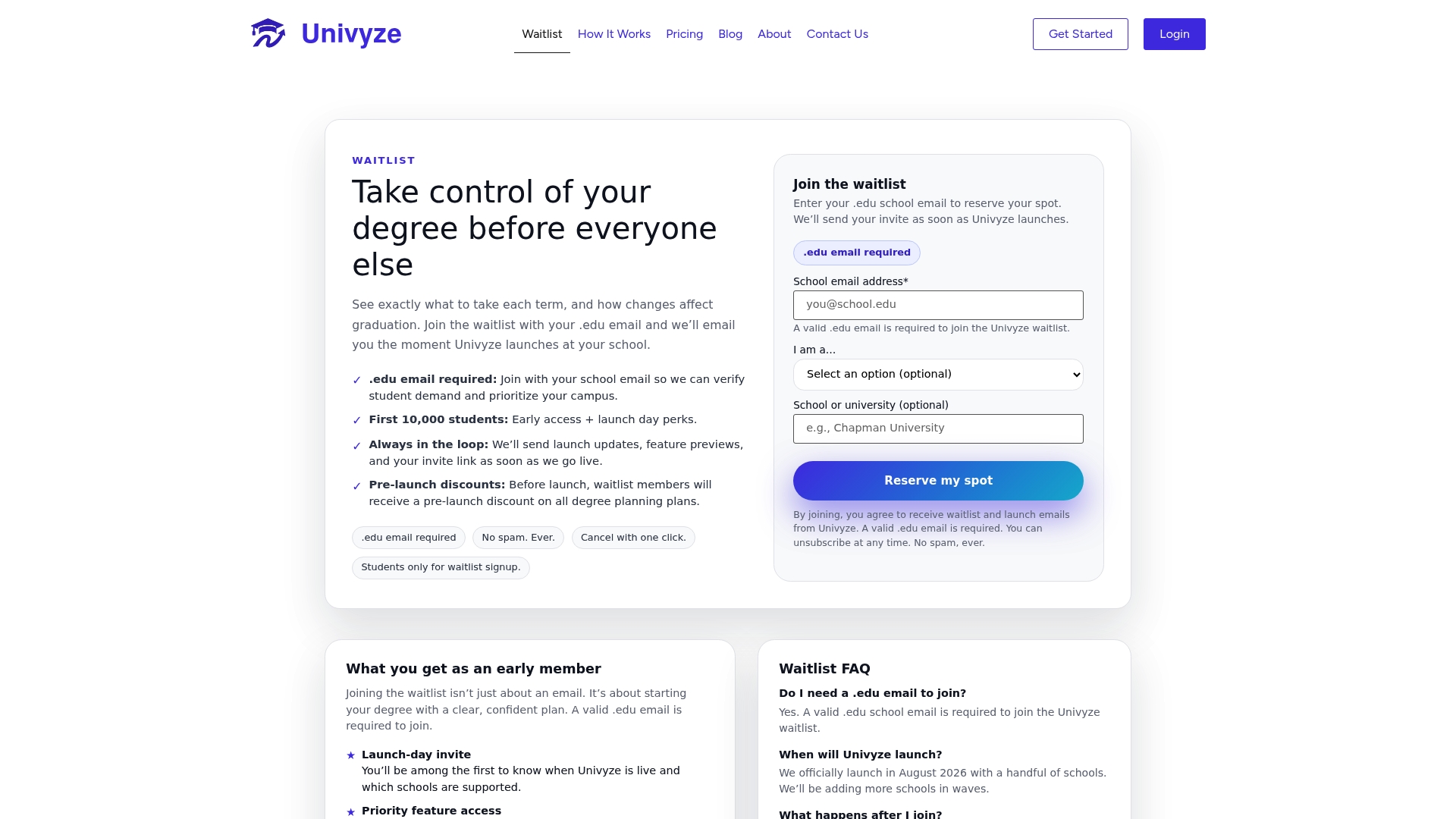
Univyze gives freshmen a dynamic dashboard that maps degree requirements against real course offerings, term by term. You can factor in AP credits, dual enrollment, transfer credits, and summer sessions to see exactly where you stand. The what-if planning feature lets you test a major change without committing, so you can see how switching from Business to Psychology affects your graduation timeline before you sign anything. Univyze complements your academic advisor. It does not replace them. For a clear look at how Univyze works, visit the features page and join the waitlist to get early access.
FAQ
When do most colleges require you to declare a major?
Most colleges require major declaration by the end of sophomore year, after completing 60–64 credits. Missing this deadline commonly results in enrollment holds or financial aid complications.
Does starting undeclared delay graduation?
Starting undeclared does not delay graduation when students use their first two years to complete general education requirements and prerequisites. Central College data shows undecided students graduate in the same typical four years as declared peers.
What is the Interest-Aptitude-Opportunity triad?
The Interest-Aptitude-Opportunity triad is a decision framework that balances personal passion, demonstrated skills, and job market demand. Using all three factors together produces better degree completion rates than relying on any single factor alone.
Should I pick a major based on salary?
Salary is one factor, but students who choose a major based solely on earning potential show higher rates of burnout and lower completion rates. Combining salary data with genuine interest and demonstrated aptitude produces more sustainable outcomes.
Can I change my major after declaring?
Most schools allow major changes, but policies vary significantly. Switching between programs within the same college is usually straightforward. Changing colleges within a university can require reapplication and may not transfer all completed credits toward the new major’s requirements.