

Unit requirements in college majors define the specific number and types of credit hours you must complete to graduate with real competence in your chosen field. This is not just an administrative formality. Unit requirements, also called credit hour requirements, exist because disciplines have minimum knowledge thresholds that cannot be met by taking a handful of loosely related courses. A typical bachelor’s degree requires 120–128 total credits, with your major accounting for 30–60 of those. Understanding why majors have unit requirements is the first step toward planning a degree path that keeps you on track and out of extra semesters.
Why majors have unit requirements: the core reason
Unit requirements exist because not all credits are equal. A university treats your degree as a set of educational specifications, not just a credit accumulation target. Each required course builds a specific competency. Without a minimum number of credits in the right categories, you could technically reach 120 credits without ever developing the skills your degree is supposed to certify.
Accreditation bodies enforce this logic from the outside. Regional accreditors and professional organizations like ABET for engineering and ACEN for nursing set baseline outcomes that programs must deliver. Those outcomes translate directly into required courses and credit minimums. The result is a structured curriculum, not an open menu.
Degree requirements consist of four main components: General Education, Major Core, University Requirements, and Electives. Each component serves a distinct purpose. Together, they produce a graduate who is broadly educated and specifically trained.
How unit requirements structure academic breadth and depth
General Education requirements give you breadth. These courses cover writing, mathematics, social sciences, arts, and natural sciences. The goal is to produce graduates who can think critically across disciplines, not just within their specialty. Most universities require 36–48 credits of General Education, regardless of your major.
Major Core requirements deliver depth. These are the courses that define your discipline. A computer science major at a school like UC Irvine will take courses in algorithms, data structures, and systems programming because those topics are non-negotiable for professional competence. Skipping them would leave gaps that employers and graduate programs notice immediately.
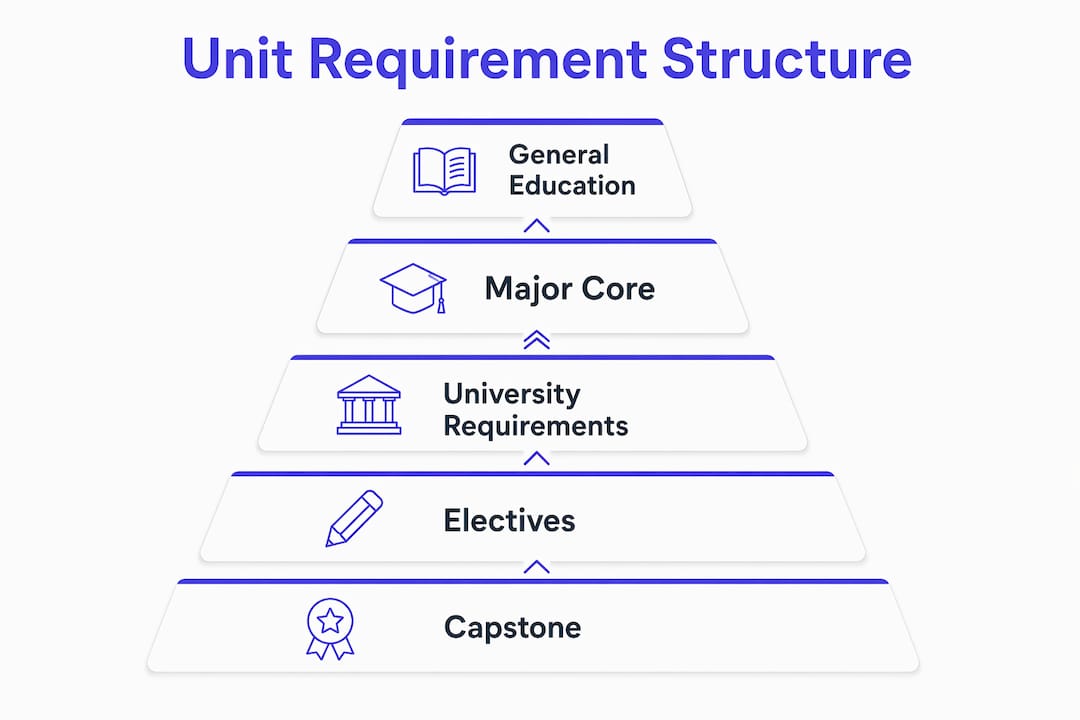
Electives fill the space between breadth and depth. They let you pursue related interests, double minor, or explore adjacent fields. University Requirements, such as writing proficiency exams or diversity course mandates, round out the picture with institution-specific standards.
Here is how the four components typically break down:
- General Education: Broad knowledge across disciplines; usually 36–48 credits
- Major Core: Discipline-specific required courses; usually 30–60 credits
- Electives: Student-chosen courses within or outside the major; variable credits
- University Requirements: Institution-specific mandates such as writing exams or residency minimums
Pro Tip: Map all four requirement categories in a spreadsheet before your first semester. Seeing the full picture early prevents the common mistake of loading up on electives while neglecting upper-division major courses.
Why do unit requirements vary so much between majors?
The standard range of 120–128 credits applies to most liberal arts and social science degrees. Specialized majors routinely exceed that ceiling. Licensure-track programs like engineering, nursing, and education often require more credits because they must satisfy both university graduation standards and external professional licensing boards simultaneously.

A 10-credit difference between two similar majors often traces back to multi-term labs, fixed prerequisite chains, and licensure prerequisites. That gap is not arbitrary. It reflects the real difference in what each program must deliver. A nursing student needs clinical hours that a psychology student does not. An engineering student needs lab sequences that a history student will never encounter.
Here is a comparison of typical credit ranges across major categories:
| Major category | Typical total credits | Major core credits | Key drivers of credit count |
|---|---|---|---|
| Liberal arts and humanities | 120 | 30–40 | Writing-intensive courses, fewer labs |
| Social sciences | 120–122 | 36–45 | Research methods, statistics sequences |
| Natural sciences | 120–128 | 40–55 | Lab sequences, upper-division prerequisites |
| Engineering | 128–136 | 55–70 | ABET accreditation, multi-term lab series |
| Nursing | 124–132 | 60–72 | ACEN standards, clinical hour requirements |
| Education | 120–128 | 48–60 | State licensure, student teaching credits |
Accreditation and licensure standards force some programs to build longer, more rigid credit structures. This is not a flaw in the system. It is the system working as intended to protect professional standards.
Pro Tip: Before committing to a major, pull up its official degree plan from the university catalog. Count the total required credits yourself. The number on the admissions brochure and the number in the catalog are not always the same.
How does course sequencing affect your graduation timeline?
Major course sequencing and prerequisite chains create constraints that go beyond simple credit counts. They control the order in which you can take courses, which directly limits how you build your semester schedule. A student who misses Organic Chemistry I cannot enroll in Organic Chemistry II the following term, regardless of how many other credits they have completed.
Sequencing matters more than most students realize at the start of their degree. Here is why prerequisite chains add real complexity to your planning:
- Courses offered once per year. Many upper-division major courses run only in fall or only in spring. Missing the offering means waiting 12 months for the next one.
- Multi-term lab series. Programs in chemistry, biology, and architecture often require labs that span two or three consecutive terms. You cannot compress them.
- Capstone and senior seminar placement. Most programs require capstones in the final year, which means all prerequisite coursework must be complete before your last two semesters.
- GPA gates. Some programs require a minimum GPA in lower-division courses before allowing enrollment in upper-division major courses. Falling below the threshold resets your timeline.
Students often mistake majors as simple checklists, but majors are sequenced curricula that build skills progressively. Missing a single required course in a tightly sequenced accredited major can delay graduation by a full semester or more. That delay costs real money in tuition, housing, and lost income.
Comparing major rigor requires examining prerequisite length, lab availability, and capstone presence. These factors influence your planning far more than credit totals alone.
Practical tips for managing your unit requirements
Effective degree planning starts with a semester-by-semester roadmap that accounts for every requirement category. Creating a detailed degree roadmap with all major and university requirements is the single most effective way to avoid last-minute graduation delays.
- Meet with your academic advisor every semester. Advisors catch conflicts between your plan and university policy that you will not find in the catalog. Schedule the meeting before registration opens, not after.
- Understand residency requirements. Residency requirements mandate that you complete a minimum portion of your major credits at your degree-granting institution. Transfer students who ignore this rule often discover they need an extra semester to satisfy it.
- Do not assume transfer credits cover major requirements. Universities cap how many transfer credits count toward the major. A course that satisfies the requirement at your community college may count only as an elective at your four-year institution.
- Track upper-division credit minimums. Most universities require a set number of credits at the 300 or 400 level. Filling your schedule with lower-division courses delays your ability to meet this threshold.
- Balance your semester load deliberately. A semester with two lab courses and a writing-intensive seminar is a heavy load. Spreading demanding courses across terms protects your GPA and your mental health.
Pro Tip: Use your university’s degree audit tool every semester to confirm which requirements each completed course satisfies. Do not rely on memory or informal advisor notes.
Institutional policies such as minimum GPA thresholds, residency credit rules, and mandatory graduation application deadlines are critical checkpoints that students routinely overlook until it is too late.
Key Takeaways
Major unit requirements exist to enforce discipline mastery, not to create obstacles. Every credit category, from General Education to Major Core, serves a defined purpose in producing a competent graduate.
| Point | Details |
|---|---|
| Unit requirements enforce mastery | Credits are educational specifications, not just accumulation targets. |
| Four components structure every degree | General Education, Major Core, Electives, and University Requirements each serve a distinct role. |
| Specialized majors exceed 120 credits | Engineering, nursing, and education programs add credits for labs, clinicals, and licensure. |
| Sequencing controls your timeline | Missing one prerequisite course can delay graduation by a full semester or more. |
| Early planning prevents costly delays | A semester-by-semester degree map, built before your first term, is the most effective planning tool. |
The thing most students learn too late about unit requirements
Most students I have seen struggle with graduation timelines share one thing in common. They treated their degree requirements as a list to check off rather than a sequence to navigate. The distinction sounds minor. The consequences are not.
A student who discovers in their junior year that a required lab course runs only in the fall, and they missed the last offering, is now looking at a fifth year. That is not a scheduling inconvenience. At many universities, that is $20,000 or more in additional costs. The unit requirement did not cause the problem. The lack of a plan did.
The other misconception I see constantly is the belief that reaching 120 credits means you are done. Credits are necessary but not sufficient. You need the right credits, in the right sequence, with the right residency split. A student who fills elective slots with interesting but non-required courses can hit 130 credits and still not qualify to graduate.
View unit requirements as a map, not a maze. The structure is there to guide you toward a credential that means something. Work with it deliberately, and it becomes a clear path. Ignore it, and it becomes the reason you are still enrolled when you expected to be working.
— Ryan
How Univyze helps you stay ahead of your unit requirements
Degree planning gets complicated fast, especially when you factor in prerequisite chains, residency rules, and shifting course availability. Univyze was built specifically to solve that problem.

Univyze’s dynamic dashboard connects your degree requirements to real course offerings at your institution, so you can see exactly which courses satisfy which requirements and in what order. The prerequisite sequence visualization shows you the full chain before you register, not after you miss a critical offering. Students at schools like CSULB and UC Irvine use Univyze to build semester-by-semester plans that account for every credit category. If you want to plan your degree path without the guesswork of reading through dense university catalogs, Univyze gives you the clarity to do it.
FAQ
What are unit requirements for a college major?
Unit requirements are the specific number and types of credit hours a student must complete within a major to earn a degree. They typically include Major Core courses, General Education, Electives, and University Requirements.
How many credits does a bachelor’s degree require?
A standard bachelor’s degree requires 120–128 credit hours, with the major itself accounting for 30–60 of those credits depending on the discipline.
Why do some majors require more than 120 credits?
Licensure-track programs like engineering and nursing must satisfy both university graduation standards and external professional accreditation requirements, which adds credits for labs, clinical hours, and professional competencies.
Can missing one course really delay my graduation?
Yes. In tightly sequenced majors, a single missed required course can delay graduation by a full semester or more because many upper-division courses run only once per year.
What is a residency requirement in a college degree?
A residency requirement mandates that students complete a minimum number of their major credits at the degree-granting institution. Transfer students who do not account for this rule often need additional time to meet it before they can graduate.