

Transfer credit evaluation is the process a college uses to decide whether coursework from another school counts toward your degree, and how. The outcome usually lands in one of three places: direct course equivalency, generic elective credit, or a “pending review” status while a department checks your syllabus. The single highest-impact move you can make right now is simple.
- Request an official transcript from every school you’ve attended.
- Track down syllabi for any course that isn’t already listed in your target school’s equivalency database.
- Submit both together, since a transcript without documentation just sits in a queue.
Get those two things moving early, and you skip most of the delays that trip up transfer students every fall.
Key Takeaways
Transfer credit evaluation depends on documentation, not luck, and students who submit official transcripts and complete syllabi early get faster, more favorable outcomes.
| Point | Details |
|---|---|
| Submit transcripts first | Official transcripts from every prior school start the evaluation clock at the registrar’s office. |
| Prepare a full syllabus | Include weekly topics, textbook edition, grading breakdown, and sample assignments when required. |
| Check equivalency tables early | A listed course match usually needs no further review; unlisted courses go to departmental review. |
| Expect two to six weeks | Manual departmental reviews run on that timeline, longer during peak enrollment periods. |
| Track posting vs. degree applicability | A credit can appear on your transcript without satisfying a specific major requirement. |
Table of Contents
- How Colleges Evaluate Transfer Credit Step by Step
- What Documents Do You Need for a Transfer Credit Evaluation?
- Where Should You Check Transfer Credit Before You Enroll?
- How Long Does Transfer Credit Evaluation Take?
- How Univyze Helps You Track Transfer Credit Once It’s Approved
- Why Registrar-First Thinking Beats Guesswork
- Sources
- FAQ
How Colleges Evaluate Transfer Credit Step by Step
The process runs through four stages, and knowing where your file sits tells you what to do next.
- Transcript intake. The registrar’s office receives your official transcript, usually through an electronic delivery service like Parchment or National Student Clearinghouse, or by direct registrar-to-registrar transmission. This step is purely administrative: names, course numbers, and credit hours get logged into the system.
- Registrar processing. Staff run an automated match against the school’s existing equivalency tables. If your course already has a documented match, it posts almost immediately. If not, it moves to the next stage.
- Departmental review. A faculty member or department chair in the relevant subject area evaluates course content directly. They’re checking course level, weekly topics, total credit hours, and whether your learning outcomes align closely enough with their own course. This is where a detailed syllabus becomes mandatory rather than optional, and turnaround here typically runs four to six weeks.
- Posting to your academic record. Once approved, the credit appears on your transcript and, separately, on your degree audit. Those are two different things: a credit can post to your transcript without applying to a specific major requirement.
The result of that review typically falls into one of three buckets: direct equivalency (the class fills a specific requirement), general elective credit (it counts toward your total hours but not a specific box), or denial, which usually means the content didn’t match closely enough or came from an unaccredited source.
Pro Tip: Ask your target school’s admissions office which department reviews your specific course before you submit anything. Departments move at wildly different speeds, and knowing the queue you’re in helps you plan around it instead of guessing.
What Documents Do You Need for a Transfer Credit Evaluation?
Two things carry the entire process: official transcripts and syllabi. Get the format wrong on either one, and you restart the clock.
Official transcripts have to come directly from your prior institution, not a copy you print from a student portal; for detailed guidelines on official transcript submission, see admission procedures. Registrars accept them through electronic delivery services, direct registrar-to-registrar transmission, or a sealed envelope mailed straight from the issuing school. A transcript that’s been opened or forwarded by the student usually gets rejected outright.
Your syllabus checklist should include:
- The weekly topic schedule or course calendar
- Textbook title, author, and edition used that semester
- A grading breakdown (weighting for exams, papers, labs)
- Lab component details, if applicable
- Instructor name and contact information
- Sample assignments, particularly for composition or writing courses, where departments often want to see actual student work product
If you took the course years ago, start with the instructor directly, then try the department office, then check for archived course pages on the school’s website. Community colleges often keep syllabus archives longer than four-year schools expect.
One number matters more than most students realize: registrar offices commonly require official transcripts before starting any evaluation, and manual departmental reviews can take two to six weeks, with timelines stretching further during peak enrollment periods. Minimum grade thresholds also apply almost everywhere. A “C” or better is common, and coursework from an institution lacking regional or national accreditation typically doesn’t transfer at all.
Where Should You Check Transfer Credit Before You Enroll?
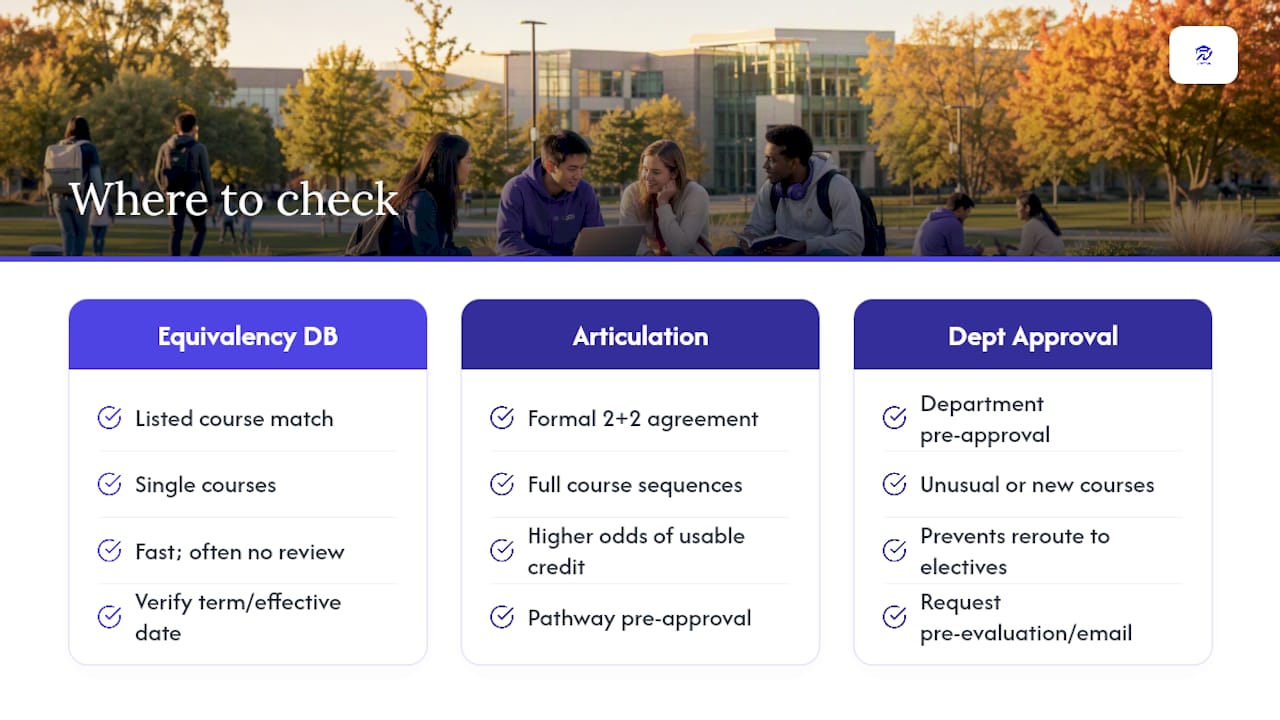
Before you take a single class with transfer intentions, check your target school’s transfer equivalency database or portal. Most public universities publish one, and it lists courses from specific community colleges alongside their exact equivalent at the four-year school.
If a course is already listed in the equivalency table, it typically requires no further review at all, which is the fastest possible outcome. A listed match isn’t a permanent guarantee, though. Course content changes, effective dates shift, and a school occasionally overhauls a whole department’s curriculum. Always confirm the match applies to the specific term you took the course.
Articulation agreements go a step further than a simple database entry. These are formal contracts between a community college and a university, often structured as 2+2 pathways, that pre-approve entire sequences of courses. Structured pathways like these substantially increase the odds that community college coursework transfers as usable credit, rather than getting rerouted into generic elective status.
Before enrolling in anything unusual, ask the department directly for pre-approval or a pre-evaluation. It costs you an email and saves you a semester.
How Long Does Transfer Credit Evaluation Take?
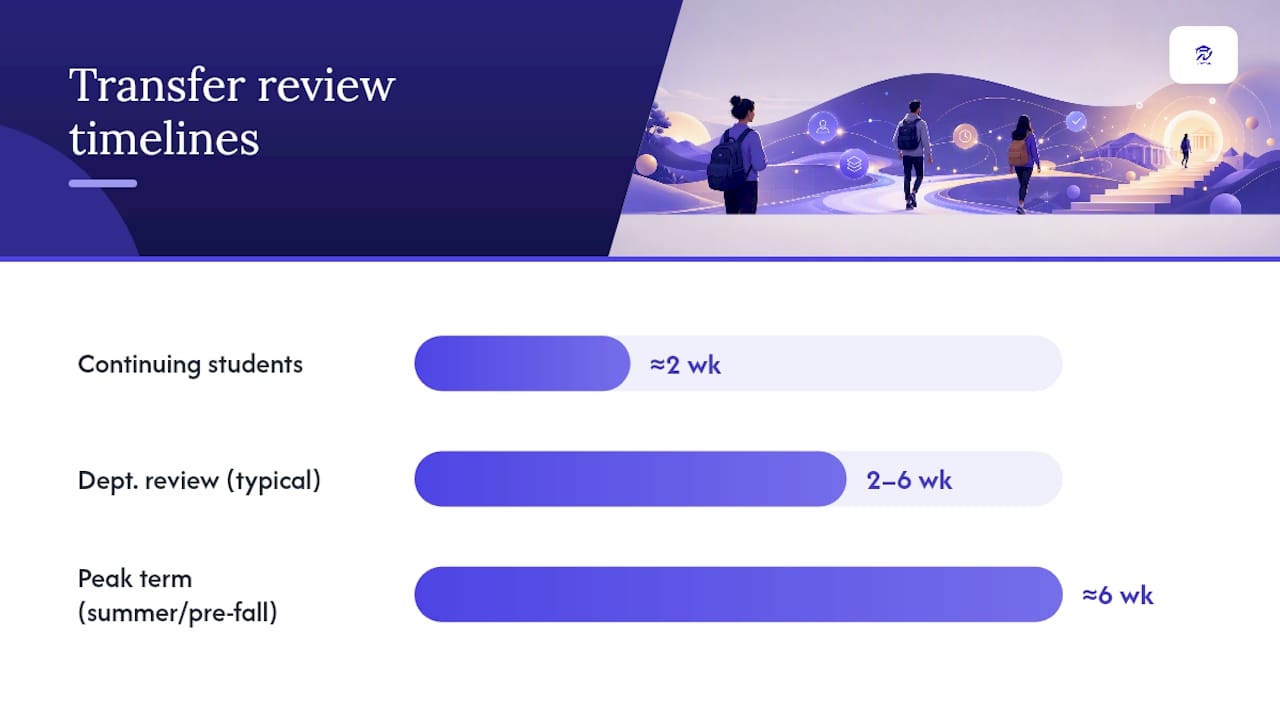
Timelines depend heavily on your status and the calendar. Newly admitted students often wait longer than continuing students, since incoming files get processed in batches around admission deadlines. Manual departmental reviews commonly run two to six weeks, and that window stretches during the summer and right before fall registration when every transfer student’s file lands at once.
Watch for status codes in your student portal. Many schools use a marker like XFRPEN, meaning “transfer pending,” to flag a course still awaiting departmental review. That status isn’t a rejection. It’s a signal to check whether the department has requested a syllabus from you yet.
If a course gets denied and you disagree, most schools offer a formal path forward:
- Talk to your academic advisor first. They often know department contacts and can flag whether your case has a real shot.
- Submit additional documentation, especially a more detailed syllabus or sample assignments the reviewer didn’t originally have.
- File a formal reevaluation or appeal request through the registrar, following whatever form and deadline your school specifies.
Keep an eye on structural limits too. Residency requirements cap how many total credits can come from outside institutions, two-year college credit often has its own ceiling separate from four-year transfer credit, and STEM or math courses frequently carry a “freshness” window, often five years, after which a school may accept the credit but block it from counting toward major progression.
How Univyze Helps You Track Transfer Credit Once It’s Approved
Getting a course approved is only half the job. The other half is figuring out where it actually fits in your remaining degree requirements, and that’s where most students lose time without realizing it.
Univyze isn’t an official evaluator and doesn’t replace your registrar or academic advisor. What it does is give you a term-by-term dashboard where approved and pending transfer credits, AP scores, and dual-enrollment courses all show up against your actual degree requirements. A few ways students use it during a transfer:
- Log each course’s evaluation status as it comes back from the department, so nothing gets lost between the registrar’s decision and your actual plan.
- Run a “what-if” scenario to see how a pending or denied course changes your remaining course sequence.
- Flag residency gaps early, before they turn into a scheduling scramble your last semester.
Pro Tip: Export your logged evaluation notes from Univyze before a meeting with your advisor or an appeal submission. Having a clean record of what was requested, submitted, and decided speeds up both conversations considerably.
Why Registrar-First Thinking Beats Guesswork
Most transfer advice online treats credit evaluation like a formality, something that happens automatically once you enroll. It doesn’t. The registrar and department reviewers are working from documentation you control, and the students who lose credit almost always lost it on paperwork, not academic merit.
The conventional wisdom, “just transfer and it’ll sort itself out,” ignores that advisors consistently flag the gap between “transferable” and “counts toward my major”. A course can post to your transcript and still do nothing for your degree audit. That distinction gets missed constantly, usually right around the semester a student realizes they’re short on major prep credits they assumed were covered.
If I had to pick one priority for a reader mid-transfer: stop treating the equivalency database as the finish line. Treat it as the starting point, then verify how each approved credit actually applies using your official degree audit and your advisor, not assumptions.
— Ryan
Sources
- The Transfer Playbook (CCRC, 2025)
- Transfer Credit Evaluation | Penn State Undergraduate Admissions
- Course credit evaluation process — UW–Madison Registrar
- Transfer Credit Evaluation — Georgia Tech
- Transfer credit policies — Northeastern (2026)
FAQ
What Is a Transfer Credit Evaluation?
It’s the process a college uses to review coursework from another institution and decide whether it counts toward your degree, either as a direct course equivalent, general elective credit, or not at all.
How Accurate Is a Transfer Equivalency Database Like Transferology?
These databases reflect prior evaluation decisions and can be a reliable starting point, but a listed match isn’t a final guarantee since course content, effective dates, and school policies change over time. Always confirm directly with the receiving institution’s registrar before assuming a match still applies.
Can College Credits Be Transferred Between Any Two Schools?
Generally, only coursework from a regionally or nationally accredited institution transfers, and even then it’s subject to the receiving school’s grade minimums, residency limits, and time restrictions on certain subjects like math and science.
Does Transferred Credit Affect Your GPA?
Most colleges transfer the credit hours but not the letter grade, meaning the course counts toward your total credits without factoring into your GPA at the new school. Policies vary, so confirm this detail with your specific registrar.
Ready to see how your evaluated transfer credits fit into an actual term-by-term plan? Join the Univyze waitlist and get early access to a dashboard built to map AP credit, dual enrollment, and transfer coursework against your real degree requirements, so nothing you’ve already earned gets lost in the shuffle.