

Expect your college GPA to run lower than your high school GPA. That’s not a warning — it’s a documented pattern backed by data from nearly 400,000 students. Understanding the college GPA vs. high school GPA differences before you arrive on campus is one of the most practical things you can do for your academic future.
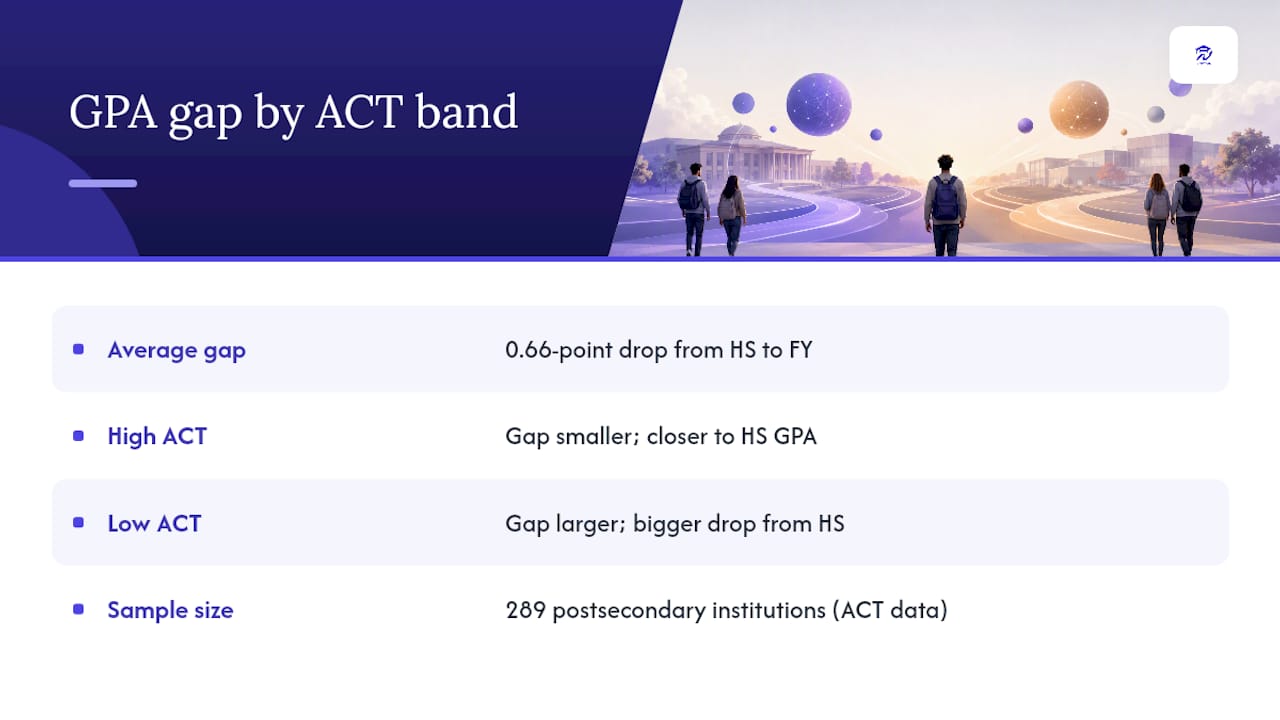
- ACT’s large-sample analysis of 392,635 students found the average high school GPA was 3.36 and the average first-year college GPA (FYGPA) was 2.70 — a gap of 0.66 points.
- The gap narrows as ACT scores rise: students with higher ACT scores tend to experience smaller drops between high school and first-year college GPA, while lower-scoring students tend to see a larger gap.
- Your first-year college GPA is the strongest predictor of your cumulative college GPA (CGPA) — stronger than your high school GPA or ACT score alone.
- Check whether your high school reports a weighted or unweighted GPA. Many colleges recalculate it on their own scale before comparing applicants.
- Plan your first semester to balance one or two challenging courses with at least one where you can protect your grade.
Key Takeaways
Your first-year college GPA is the strongest predictor of your cumulative GPA, making first-semester course strategy the highest-leverage decision you’ll make in college.
| Point | Details |
|---|---|
| Average GPA gap is 0.66 points | ACT data from 392,635 students shows HSGPA averages 3.36 vs. FYGPA at 2.70. |
| FYGPA drives cumulative outcomes | Research shows FYGPA mediates ACT score’s effect on CGPA and explains ~59.3% of variance in combined models. |
| Colleges recalculate your GPA | Many schools strip weighting and use their own scale; check the Common Data Set for school-specific benchmarks. |
| GPA affects scholarships and timelines | Falling below renewal thresholds or failing prerequisites can add a full semester and significant tuition costs. |
| Univyze maps your degree path | Term-by-term planning, AP/dual-enrollment integration, and what-if scenarios help you protect GPA and stay on track. |
Table of Contents
- How do college GPA and high school GPA actually differ?
- Why does your GPA usually drop in college?
- How well do high school GPA and test scores predict college success?
- What do GPA differences mean for your college experience?
- Concrete steps to narrow the GPA gap before and during college
- How Univyze helps you manage GPA risk and degree progress
- Who should you contact on campus, and when?
- A note on planning proactively
- Univyze helps you plan smarter from day one
- Sources
- FAQ
How do college GPA and high school GPA actually differ?
The numeric gap between high school and college GPA is well-documented, and the sample sizes behind it are large enough to trust.
ACT’s data byte drew from 289 postsecondary institutions and found that average FYGPA sits about two-thirds of a point below average HSGPA. That gap is not uniform. Students with higher ACT Composite scores tend to land closer to their high school performance in college. The drop is steepest for students whose test scores suggest a mismatch between their grades and their academic preparation.
The average GPA drop from high school to first-year college is 0.66 points — and that gap is the single most consistent finding across large-sample studies of college readiness.
Admission trends reinforce why this matters. Even as acceptance rates shifted between 2017 and 2021, NACAC data shows that high school grades remained a central factor in admission decisions. Colleges also consult the Common Data Set, which aggregates middle-50% GPA and test-score ranges for over 100 institutions, so you can benchmark your own numbers against schools you’re targeting.
Key figures to keep in mind include the general average high school and first-year college GPAs reported in the ACT analysis and the pattern that the GPA gap varies depending on ACT scores, with lower scores associated with larger gaps and higher scores with smaller gaps.
Why does your GPA usually drop in college?
The drop happens for several reasons, and most of them are predictable once you know what to look for.
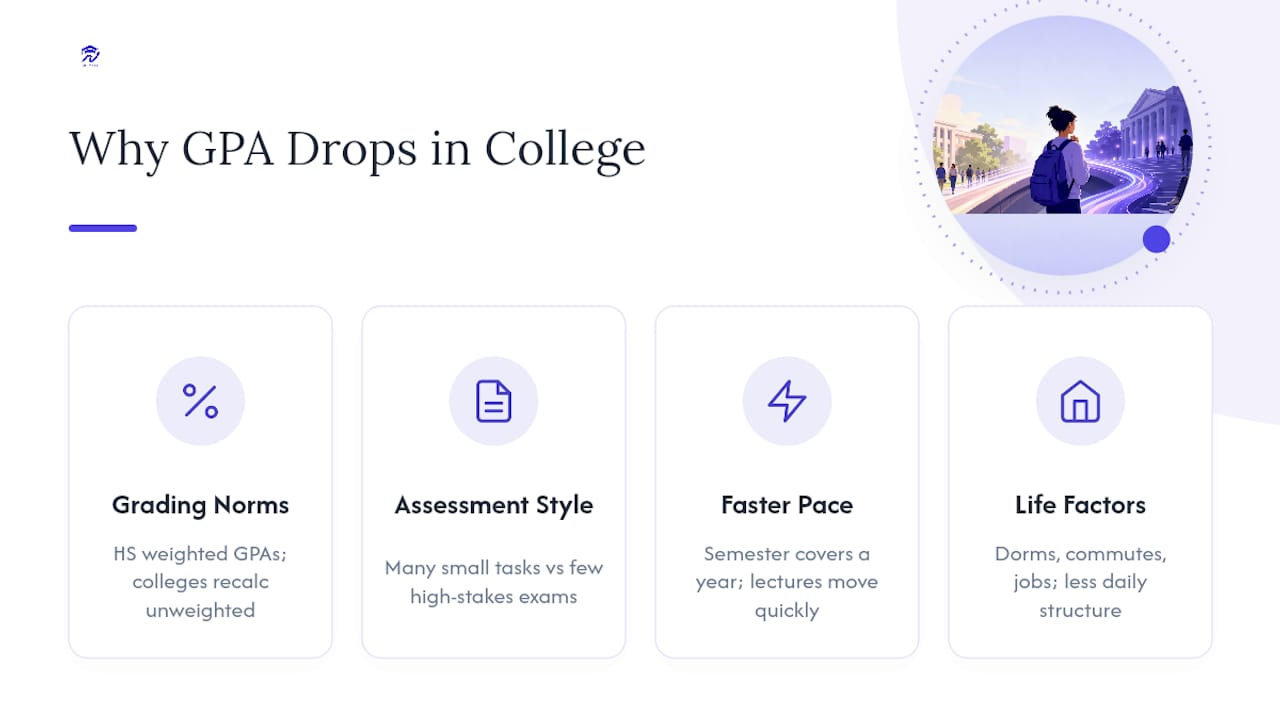
Grading norms shift. High schools often weight grades for Honors, AP, and IB courses, adding +0.5 or +1.0 points to the base 4.0 scale. College Transitions explains that a weighted GPA can easily exceed 4.0 in high school, but most colleges recalculate applicants’ GPAs on a standard unweighted scale to compare them fairly. Once you’re enrolled, college departments set their own grading curves — and introductory STEM courses in particular are notorious for tight curves that pull class averages below a 3.0.
Assessment styles are different. In high school, your grade often reflects homework completion, participation, and multiple smaller tests. In college, two or three high-stakes exams may determine your entire grade. A single bad midterm can do real damage to a semester GPA in a way that a missed homework assignment never could.
The pace is faster. A semester covers roughly the same material as a full year in many high school courses. Lectures move quickly, and professors rarely circle back to reteach a concept.
Life gets complicated. Dorm transitions, commutes, part-time jobs, and the absence of the daily structure high school provided all hit at once during the first semester. These nonacademic factors directly affect FYGPA — and FYGPA, as the research shows, sets the trajectory for everything that follows.
Pro Tip: Before your first semester, use College Transitions’ GPA calculator to convert your weighted high school GPA to an unweighted equivalent. That’s the number most colleges will actually compare.
How well do high school GPA and test scores predict college success?
Both HSGPA and ACT/SAT scores predict early college performance, but neither tells the full story on its own.
A path analysis and hierarchical linear modeling study (ED673778) found that FYGPA mediates the relationship between ACT score and cumulative college GPA. In plain terms: your ACT score influences your first-year GPA, and your first-year GPA then drives your cumulative GPA. Once FYGPA and demographic factors enter the model, the direct effects of HSGPA and ACT score shrink. The combined model explained approximately 59.3% of the variance in CGPA.
FYGPA is the strongest single predictor of cumulative college GPA in models that include HSGPA, ACT score, and demographics — which means protecting your first-year grades is the highest-leverage move you can make.
What admissions officers actually use is more nuanced than a single number. Great College Advice notes that colleges evaluate GPA in context: what courses were available at your school, how rigorous your transcript looks relative to your peers, and whether your grades trended upward. A 3.5 unweighted GPA from a student who took every AP offered carries more weight than the same number from a lighter course load.
Practical takeaways:
- HSGPA and ACT/SAT both predict FYGPA, but neither is destiny.
- FYGPA is the pivot point — it shapes cumulative GPA more than any single precollege measure.
- Admissions readers use school profiles and course rigor, not just the GPA number itself.
What do GPA differences mean for your college experience?
The gap between high school and college GPA has real downstream consequences — financial, academic, and logistical.
Admissions. Many colleges recalculate your GPA on their own scale. A high weighted GPA may look different after recalculation. Use the Common Data Set Explorer to find the middle-50% GPA range for admitted students at schools you’re considering, then compare your recalculated number.
Placement and prerequisites. A low FYGPA can lock you out of major gateway courses that require a minimum grade — often a B or better. Falling short in a prerequisite means retaking it, which costs a semester and tuition dollars.
Scholarships. Most merit scholarships require a minimum cumulative GPA, typically 3.0 or higher, for annual renewal. Dropping below that threshold mid-degree can eliminate funding you were counting on.
Graduation timeline. Failed or repeated courses push graduation back. One extra semester at a four-year university can cost tens of thousands of dollars in tuition and living expenses, plus delayed earnings. Knowing which courses count toward your degree from day one prevents that kind of drift.
Concrete steps to narrow the GPA gap before and during college
Before you arrive
- Take AP or dual-enrollment courses strategically. Earning college credit in high school reduces your first-semester load and gives you a preview of college-level grading. Verify how each prospective college handles AP credit, dual enrollment, and transfer credits — policies vary widely.
- Focus on core-course rigor. Admissions readers and placement systems both look at performance in math, English, science, and social studies. Strong grades in those subjects carry more weight than elective padding.
- Research your target schools’ GPA recalculation policies. Some schools strip weighting entirely; others keep it. Knowing this before you apply helps you frame your transcript accurately.
During your first year
- Balance your schedule. Pair one or two demanding courses with at least one where you can reasonably earn an A. A first-year course planning checklist can help you map this out before registration opens.
- Identify major gateway courses early. Know which courses require a minimum grade and prioritize them. Failing a gateway course is one of the most common reasons students add an extra semester.
- Use office hours in week one, not week ten. Professors notice students who show up early, and the relationship pays off when you need a grade appeal or a recommendation letter.
Pro Tip: Active recall and spaced repetition — testing yourself on material rather than rereading notes — consistently outperform passive study methods in college-level courses. Apps like Anki make this easy to build into a daily routine.
- Use tutoring centers before you need them. Supplemental instruction and subject tutoring are most effective when started early, not as a rescue measure after a bad midterm.
- Consider summer courses or retake policies for any course where you earned a C or below. Many schools allow grade replacement, which can protect your cumulative GPA.
For students planning ahead on test prep, WonPrep offers ACT and SAT tutoring that can help you enter college with a stronger academic foundation — which the ACT data suggests correlates with a smaller GPA drop.
How Univyze helps you manage GPA risk and degree progress
Degree-planning tools can’t take your exams, but they can prevent the planning mistakes that cost students extra semesters. Univyze gives you a visual map of your degree requirements connected to real course offerings, so you can see exactly where you stand and what comes next.
Features directly relevant to GPA protection:
- Term-by-term planning that shows which courses to take each semester and in what order, reducing the risk of missing prerequisites.
- AP, dual-enrollment, and transfer credit integration so precollege credits are reflected in your plan from day one.
- What-if scenario planning that lets you model a major change or a failed course before it becomes a registrar problem.
- Progress tracking that flags when you’re drifting from your graduation timeline.
Pro Tip: Univyze is a planning tool, not an official degree audit. Always verify your requirements with your registrar, academic advisor, and university catalog before making enrollment decisions.
Univyze is not a substitute for your academic advisor — it’s what you bring to that advising meeting so the conversation is about strategy, not catching up on basics. Learn more about how Univyze’s term-by-term planning works and how it connects to tracking your graduation progress.
Who should you contact on campus, and when?
Academic advisor. Go here first for degree requirements, major prerequisites, what-if scenarios, and transfer-credit questions. Schedule a meeting before your first registration, not after.
Tutoring and learning centers. Most campuses offer free subject tutoring, study-skills workshops, and supplemental instruction. Campus resources play a measurable role in graduation success — use them in the first month, not the last.
Registrar. For official enrollment verification, grade replacement requests, and leave-of-absence implications on your academic standing.
Financial aid office. If your GPA drops near a scholarship renewal threshold, contact financial aid immediately. Many offices have appeal processes, but deadlines are strict.
Disability services. If a learning difference or mental health condition is affecting your performance, accommodations are available — but you have to register. Don’t wait until grades are already suffering.
A note on planning proactively
The students who struggle most with the college GPA gap aren’t the least prepared academically. They’re often the ones who assumed their high school habits would transfer automatically. They skip the advising appointment, overload their first semester because they’re used to handling a lot, and don’t realize a gateway course requires a B until they’re already in it with a C average.
Proactive planning — knowing your degree map, your scholarship thresholds, and your first-semester course balance before week one — is what separates students who recover quickly from those who spend an extra semester catching up.
Verify everything with official campus sources: your registrar, your university catalog, and your academic advisor. No planning tool, including Univyze, replaces that verification step.
Univyze helps you plan smarter from day one
The research is clear: your first-year GPA sets the trajectory for your entire college career. One semester of poor course sequencing or an overlooked prerequisite can push graduation back by a full term — and that costs real money.

Univyze gives you a dynamic dashboard that maps your degree requirements to real course offerings, handles AP and dual-enrollment credits automatically, and lets you run what-if scenarios before you commit to a schedule. It’s built for students who want to see the full picture, not just the current semester.
Build your term-by-term degree plan and join the Univyze waitlist to get early access. Always confirm your official requirements with your registrar and advisor — Univyze helps you plan smarter, not replace that step.
Sources
- ED673778 (path analysis / HLM study on HSGPA, ACTC score, FYGPA, CGPA)
- Comparing High School GPA to First-Year College GPA (ACT Data Byte)
- Common Data Set Explorer 2026: Compare 104 Colleges | GradGPT
Consult your college’s own Common Data Set page and registrar for school-specific GPA distributions and admission-factor weightings.
FAQ
What is the average GPA drop from high school to college?
The average drop is approximately 0.66 points, based on ACT data from 392,635 students — from a mean HSGPA of 3.36 to a mean FYGPA of 2.70. The gap is smaller for students with higher ACT Composite scores.
Why does college GPA matter more than high school GPA?
Once you’re enrolled, your first-year college GPA is the strongest predictor of your cumulative GPA, according to path-analysis research. It also directly affects scholarship renewal, major prerequisite eligibility, and graduation timeline.
Do colleges recalculate your high school GPA?
Yes. Many colleges strip weighted points and convert your GPA to a standard 4.0 scale for comparison. Check the Common Data Set for your target schools to see the middle-50% GPA range of admitted students.
How can I protect my GPA in the first college semester?
Balance your schedule by pairing demanding courses with at least one where you can earn a strong grade, identify major gateway courses early, and use tutoring and office hours before midterms — not after a bad exam.
Can Univyze help me manage my GPA and degree requirements?
Univyze helps you plan term-by-term, integrate AP and dual-enrollment credits, and model what-if scenarios for major changes. It’s a planning tool, not an official degree audit — always verify requirements with your registrar and academic advisor.
Recommended
- How to Pick the Best College Classes for Your Schedule and GPA – univyze.com
- How to Choose Classes That Actually Count Toward Graduation (And Avoid Wasting Time and Money) – univyze.com
- How Many Credits Should You Take Per Semester? A Complete College Planning Guide – univyze.com
- How to get better grades in college? – univyze.com