

A college major is the primary subject area you specialize in during your undergraduate degree. If you major in biology, your focused coursework will include classes like Cell Biology, Genetics, and Ecology — courses that build deep knowledge in one field. The major sits inside your degree: it is not the credential itself (that’s your BA or BS) but the concentrated field of study that shapes most of your upper-division classes.
Table of Contents
- What is a college major, and how is it structured?
- How does a major differ from your degree?
- How many credits does a major take, and when do you declare?
- What types of majors will you encounter?
- Double majors, minors, and concentrations: what’s the tradeoff?
- Why does your major matter for careers and grad school?
- How to choose a college major: a practical checklist
- How to plan and track your major requirements
- Key Takeaways
- The part most students get wrong about picking a major
- Univyze helps you plan your major without the guesswork
- Useful sources to verify your major requirements
- FAQ
What is a college major, and how is it structured?
Major requirements are administered by academic departments, not by a central university office. Your department sets which courses are required, which count as electives within the major, and what a capstone or senior project looks like. That distinction matters practically: if you want a waiver or substitution, you talk to your department, not just the registrar.
A typical major has three layers:
- Core courses: Required classes every student in the program takes (e.g., Organic Chemistry for chemistry majors, Microeconomics for economics majors).
- Major electives: A set of approved upper-division courses where you pick based on interest or career direction.
- Capstone or internship: Many programs end with a senior seminar, thesis, or supervised internship that ties the work together.
A psychology major, for example, might require Introduction to Psychology, Research Methods, Statistics for Behavioral Sciences, and Abnormal Psychology as core courses, then let students choose three electives from areas like neuroscience, social psychology, or clinical topics.
Pro Tip: Find your program’s four-year plan (sometimes called a “program guide” or “degree map”) on your department’s website before you register for anything. Reading a senior seminar syllabus in your first semester tells you exactly where the major is heading.
How does a major differ from your degree?
People use “major” and “degree” interchangeably all the time. They mean different things.

Your degree is the credential your university awards when you complete all requirements: a Bachelor of Arts (BA), Bachelor of Science (BS), or another bachelor’s designation. Your major is the specific discipline you specialize in within that degree. You earn one degree; your major is what you studied to get there.
Here’s how credits typically split inside a 120-credit bachelor’s degree:
- Major coursework: ~30–36 credits of discipline-specific classes
- General education (gen ed): ~30–40 credits covering writing, math, social sciences, arts, and sciences
- Free electives: The remaining credits, which you can use for a minor, a second major, or courses you simply want to take
Two quick examples: a student earning a BS in biology takes the same general education requirements as a student earning a BA in history — but their major courses are entirely different, and the BS often carries more lab and quantitative requirements than the BA.
How many credits does a major take, and when do you declare?
Most majors require roughly 30–36 credits of major-specific coursework within a ~120-credit bachelor’s degree.
That means your major accounts for about a quarter to a third of your total college coursework. The rest goes to gen ed, electives, and any minor or second major you add.
On timing, students are commonly advised to remain undeclared through the first year or into sophomore year. Most schools set a formal declaration deadline around the end of sophomore year (60 credits), though some competitive programs — nursing, engineering, architecture — require earlier admission directly into the major.
A rough timeline looks like this:
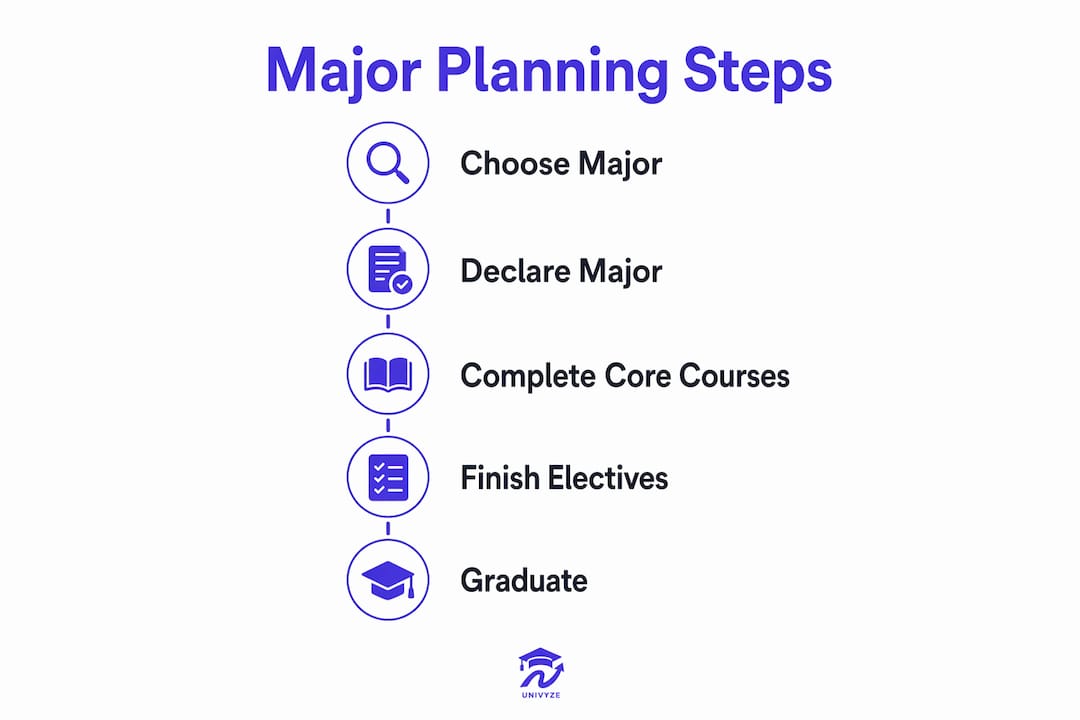
- Freshman year: Take gen ed requirements and one or two intro courses in fields that interest you. Treat this as low-stakes exploration.
- Sophomore year: Narrow to one or two serious candidates. Meet with advisors in those departments.
- End of sophomore year: Declare your major officially through your registrar or advising portal.
- Junior and senior years: Complete upper-division major requirements, electives, and your capstone.
One warning worth taking seriously: changing majors late can delay graduation because earlier coursework may not satisfy new departmental requirements. A switch from English to nursing after junior year, for instance, could mean starting a new prerequisite sequence almost from scratch. That’s an extra semester or two of tuition and living costs.
What types of majors will you encounter?
Not every school uses the same vocabulary, and that can confuse students researching programs. Here’s what the common terms actually mean:
- BA (Bachelor of Arts): Typically emphasizes humanities, social sciences, and interdisciplinary study. More flexibility in elective choices.
- BS (Bachelor of Science): Usually requires more math, lab science, or technical coursework. Common in STEM, business, and health fields.
- Concentration: A focused track within a major (e.g., a marketing concentration inside a business major). At some schools, “concentration” is used where others say “major”) — always check your school’s catalog for the exact definition.
- Interdisciplinary major: Spans two or more departments. Women’s studies, cognitive science, and environmental studies are common examples. These are often administered across faculty committees.
- Self-designed major: Some schools let students propose a custom major combining courses from multiple fields, subject to faculty approval.
The same program can carry different names at different schools. “Computer science” at one university might be housed in a College of Engineering (BS), while another offers it through a College of Arts and Sciences (BA). Same skills, different packaging.
Double majors, minors, and concentrations: what’s the tradeoff?
Adding a second major or a minor can strengthen your profile, but it comes with real costs.
Definitions:
- Double major: Completing all requirements for two separate majors within one degree. You graduate with one credential but two fields of specialization.
- Minor: A shorter sequence of courses (typically 18–24 credits) in a secondary field. Less depth than a major, but enough to signal genuine interest.
- Concentration/coordinate major: A structured sub-track within a major, or a closely paired secondary field at schools that use that term.
Tradeoffs to weigh:
- A double major adds depth and can open doors in fields that value both disciplines (e.g., economics + computer science for fintech roles).
- It also adds 30+ credits to your plan, which can create scheduling conflicts and push graduation back a semester or more.
- A minor is often a smarter move when you want breadth without the full credit load.
- Late major changes compound these issues: if you add a second major in junior year, you may not have room in your schedule to finish both on time.
Before committing to a double major, map out every required course for both programs and check for time conflicts. What looks manageable on paper can become a scheduling puzzle in practice.
Why does your major matter for careers and grad school?
Here’s the honest picture: only about 27% of graduates end up working in jobs directly related to their major. That number should relieve some pressure. Your major shapes your first job search more than your long-term career trajectory.
For early career screening, some fields are tightly coupled to the major. Nursing, accounting, and engineering require specific credentials that come from specific programs. For most other fields, employers look at transferable skills: analytical writing, quantitative reasoning, research methods, and the ability to communicate clearly under pressure. A history major who can write and argue a position has skills a consulting firm will pay for.
Where majors matter most for grad school: law schools accept any major but want strong writing and logic; medical schools require specific science prerequisites regardless of major; MBA programs typically want work experience more than a particular undergraduate field.
Pro Tip: Use the three-factor test before declaring: Does this subject genuinely interest you? Do you have real aptitude for it? Does the job market support it? All three should point in roughly the same direction. If one is badly misaligned, that’s worth addressing before you’re 60 credits in.
Also factor in cost. Program fees, expected graduate-school sequences, and projected starting salaries vary significantly by field. If you’re borrowing to pay for college, a major with a clear salary trajectory and low additional program costs deserves extra weight in your decision.
How to choose a college major: a practical checklist
The goal isn’t to find the perfect major. Experts recommend balancing interest, aptitude, and opportunity, then backing that choice with real experience. Here’s a step-by-step approach:
- Take two or three intro courses in fields that interest you before declaring. Gut reactions to actual coursework are more reliable than abstract interest.
- Read a senior seminar syllabus for any major you’re seriously considering. If the capstone work excites you, that’s a signal. If it feels like a slog, pay attention to that too.
- Talk to upperclass students in the program. Ask what surprised them, what they’d do differently, and what the job search looked like.
- Use a career assessment (the Strong Interest Inventory or O*NET Interest Profiler are widely used starting points) to surface fields you might not have considered.
- Do a short internship or job shadow before junior year if at all possible. Nothing clarifies a career direction faster than seeing the actual work.
- Ask an advisor in the department these three questions: What do graduates typically do in their first year out? What prerequisites are non-negotiable? What does the capstone require?
For choosing a college major as a freshman, AP credits and dual enrollment coursework can buy you time. If you’ve already completed the equivalent of intro-level courses, you can move into upper-division classes earlier and test your fit with the major before you’re formally committed. Summer sessions work the same way: a summer course in a potential major is a low-risk way to test the waters before the fall declaration deadline.
When weighing broad vs. niche majors, broader majors (psychology, communications, business) offer more flexibility in the job market. Niche majors (actuarial science, supply chain management) can be powerful if the fit is right, but they leave less room to pivot. Build fallback skills regardless: a second language, coding basics, or data literacy adds value to almost any major.
For more guidance on how to choose the right college major, including how to weigh your options against real career data, Univyze has a dedicated resource worth bookmarking.
How to plan and track your major requirements
Knowing what your major requires is one thing. Tracking whether you’re actually on pace to finish it is another. Most students rely on a combination of their school’s official degree audit system and their own notes. That combination works, but it has gaps: degree audit tools don’t always show scheduling conflicts, and they rarely model what happens if you change your major or add a minor.
Univyze is built specifically for this problem. Its features that matter most for major planning:
| Feature | What it does for you |
|---|---|
| Visual degree map | Shows every requirement for your major laid out by term, so you can see the full path at once |
| Term-by-term planning | Builds a semester-by-semester schedule that accounts for prerequisites and credit load |
| What-if scenarios | Lets you model a major change or minor addition without committing, so you can see the impact on your timeline |
| AP/transfer credit handling | Applies your existing credits to requirements so you know exactly where you stand |
| Schedule conflict detection | Flags when two required courses overlap before you register |
Pro Tip: Use Univyze alongside your school’s official degree audit, not instead of it. The official audit is the authoritative record; Univyze helps you plan and scenario-test before you walk into your advisor’s office. Always verify final requirements with your registrar and academic advisor.
Univyze also gives parents a shared view of their student’s academic progress, which reduces the “how are things going?” guesswork that tends to spike around registration deadlines.
Key Takeaways
A college major is a concentrated field of study within your degree that typically accounts for 30–36 credits of your total 120-credit bachelor’s program, and choosing it strategically, with the right planning tools, shapes both your academic timeline and your early career options.
| Point | Details |
|---|---|
| What a major is | A focused field of study within your degree, distinct from the credential (BA/BS) itself. |
| Credit footprint | Major coursework typically covers 30–36 credits out of a ~120-credit bachelor’s degree. |
| When to declare | Most schools expect declaration by end of sophomore year; explore freely in year one. |
| Career reality | Only about 27% of graduates work directly in their major field; transferable skills matter more long-term. |
| Univyze for planning | Univyze maps your major requirements term by term and models what-if scenarios; always verify with your advisor and registrar. |
The part most students get wrong about picking a major
The conventional advice is to “follow your passion.” That framing causes real harm. Students who pick a major purely on passion, without checking aptitude or job-market reality, often find themselves 90 credits in and deeply uncertain. The pressure to have chosen correctly compounds the problem.
What actually works is treating your first year as a structured experiment, not a commitment. Take courses in two or three fields. Read the syllabi for senior-year classes. Talk to people who graduated from the programs you’re considering, not just current students who are still inside the experience. The goal is data, not certainty.
The other thing students underestimate is how much a late major change costs, not just emotionally but financially. An extra semester of tuition and living expenses is a real number. That’s why planning tools and what-if scenarios aren’t just organizational conveniences; they’re financial decisions. Knowing in October of sophomore year that switching from engineering to business will cost you one extra semester gives you time to decide deliberately, not reactively.
Your major is a starting point, not a life sentence. But starting points matter, and the students who plan them carefully tend to have more options, not fewer.
Univyze helps you plan your major without the guesswork
Picking a major is one decision. Staying on track through four years of prerequisites, schedule conflicts, and possible pivots is a different challenge entirely. Univyze gives you a term-by-term degree plan that maps every major requirement against real course offerings, flags conflicts before they become problems, and models what happens if you change direction.

You can apply AP credits, dual enrollment, and transfer credits directly in the platform to see exactly where you stand. The what-if planning feature lets you test a major change or minor addition before you commit, so you walk into your advisor’s office with a clear picture instead of a list of questions.
Univyze is a planning tool, not an official degree audit or a substitute for your academic advisor. Always verify your final requirements with your registrar, university catalog, and advisor before making any official changes.
Ready to map out your path? Join the Univyze waitlist and start planning smarter.
Useful sources to verify your major requirements
Before you declare, change, or finalize any major requirements, go to the primary sources. Here’s where to look and what each one tells you:
| Source | What it tells you | Where to find it |
|---|---|---|
| University catalog | Official course requirements, credit minimums, and capstone rules for every major | Your school’s registrar or academic affairs website |
| Official degree audit | Your personal progress toward all graduation requirements | Student portal (e.g., DegreeWorks, DARS, Stellic) |
| Departmental advisor | Program-specific substitutions, waivers, and sequencing advice | Your major’s department office |
| Program handbook | Detailed policies on prerequisites, GPA requirements, and internship rules | Department website or advising center |
| Registrar’s office | Transfer credit evaluation, official enrollment changes, and graduation application | Campus registrar |
A few things worth pulling before your first advising appointment:
- Your current unofficial transcript (to confirm which credits have posted)
- The four-year degree map for your intended major
- A list of any AP, dual enrollment, or transfer credits you’re expecting to apply
- The degree requirement checklist for your program, which you can cross-reference against your degree audit
For broader college planning context, the resources at Top College Coach are worth reviewing if you’re still in the school-selection phase and want guidance on how major availability varies by institution.
FAQ
Is a major the same as a degree?
No. Your degree (BA, BS, etc.) is the credential your university awards; your major is the specific field of study you complete within that degree. You can think of the degree as the container and the major as what fills it.
What are the top three most popular college majors?
Business, health professions, and social sciences consistently rank among the most commonly declared majors at U.S. colleges and universities, according to federal enrollment data.
What is the hardest college major?
Engineering, nursing, and biochemistry are widely cited as the most demanding majors due to their heavy math, lab, and clinical requirements. Difficulty is also personal: a major that plays to your strengths will feel more manageable than one that doesn’t, regardless of reputation.
What are the four main types of college degrees?
The four standard undergraduate and graduate degree levels in the U.S. are the associate degree (two years), bachelor’s degree (four years), master’s degree (one to two years post-bachelor’s), and doctoral degree (three or more years post-bachelor’s). A major applies primarily at the bachelor’s level.
Can you change your major after declaring?
Yes, and it’s common. The key risk is timing: changing majors late can require additional semesters because earlier coursework may not satisfy new requirements. Use what-if planning tools and meet with an advisor before making any official change.