

Electives are courses students choose beyond their core major and general education requirements to shape their education around personal interests, career goals, and skill gaps. Understanding why electives matter in your degree plan is not optional knowledge. A typical 120-credit bachelor’s degree allocates roughly 30 credits to open electives outside general education and major requirements. That is 25% of your entire degree. Choosing those credits without a plan can cost you an extra semester, or more.
Why electives matter in your degree plan
Electives are not filler credits. They are a structured part of your degree that, when chosen well, build skills, signal competence to employers, and keep you on track to graduate. When chosen poorly, they waste money and delay graduation.

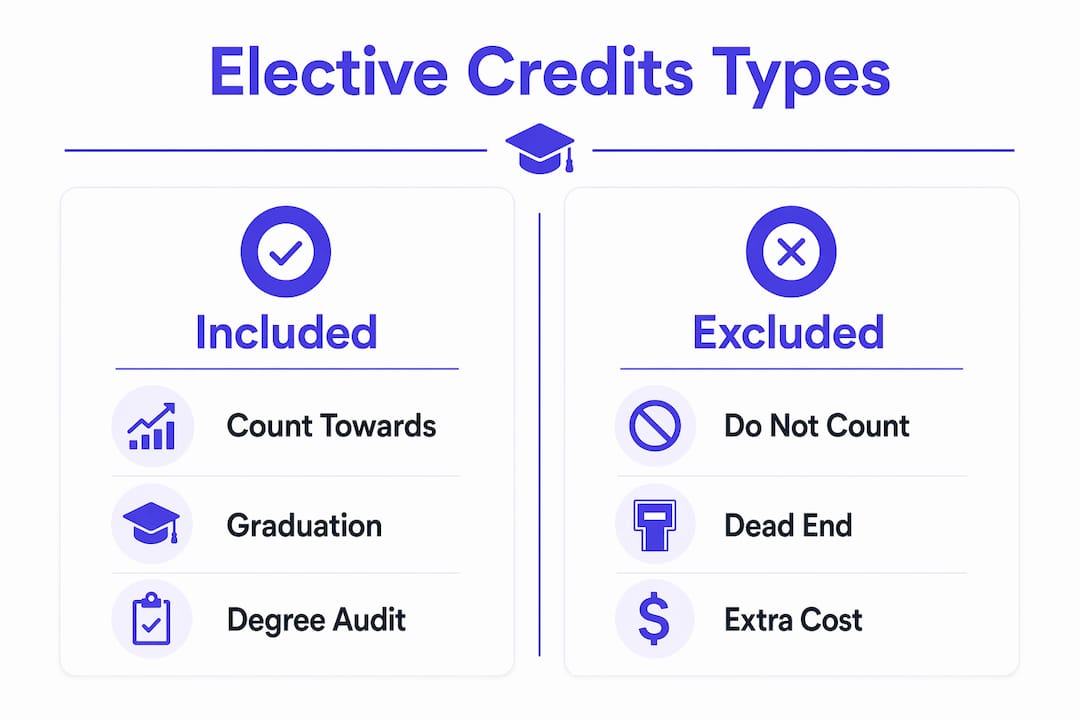
The first thing to understand is that not all elective credits are equal. Degree audit systems like Degree Works classify elective credits as either “included” or “excluded.” Included credits count toward your minimum graduation requirement. Excluded credits appear on your transcript and affect your GPA, but they do not reduce the credit total you need to graduate. That distinction matters more than most students realize.
A student who takes three excluded electives thinking they are making progress toward graduation is not. They are paying tuition and earning grades, but their graduation credit counter does not move. Catching this early is the difference between graduating on time and paying for an extra semester.
How electives fit within degree requirements and credit structures
A standard bachelor’s degree breaks into three main credit categories: general education requirements, major core requirements, and elective credits. Each category has rules about what counts and what does not.
| Credit Category | Typical Credit Range | Degree Audit Classification |
|---|---|---|
| General education | 30–45 credits | Included |
| Major core requirements | 30–60 credits | Included |
| Free electives | 15–30 credits | Included or excluded (varies) |
| Excess electives | Varies | Often excluded |
General education requirements cover foundational competencies like communication and critical thinking. These are baseline skills that prepare you for advanced major coursework. Electives sit outside that foundation, but they still need to fit within the credit buckets your degree audit defines.
The practical move is to run a degree audit before registering for any elective. Tools like Degree Works, used at institutions including East Carolina University, show exactly which credit buckets are full and which still need credits. If a course drops into an excluded bucket, it will not help you graduate faster. Mapping electives to degree requirements before you register is the only way to avoid this trap.
Elective credits can also become dead ends if you do not differentiate between general education electives, free electives, and major electives. Each category has its own rules. A course that satisfies a free elective slot may not satisfy a major elective requirement, even if the subject matter is closely related. Read your degree plan carefully and confirm with your academic advisor before you commit.
Do prerequisites and sequencing affect elective choices?
Electives are not always free choices. Many carry prerequisites, and ignoring those prerequisite chains can delay graduation just as much as taking the wrong course.
Here is how sequencing problems happen in practice:
- A student wants to take an upper-division psychology elective in their junior year.
- The course requires two lower-division psychology courses as prerequisites.
- The student has not taken those prerequisites and cannot enroll.
- The elective slot remains unfilled, and the student scrambles for a replacement that may not fit their plan.
This scenario is common. Program rules and academic advisors consistently recommend verifying prerequisites and sequencing for electives before finalizing a schedule. Engineering programs, for example, often specify compulsory versus elective course distinctions with explicit prerequisite chains that must be followed in order.
Term availability adds another layer. Some electives are only offered once a year. If you plan to take a course in the spring and it is only offered in the fall, you lose a full year of flexibility. Check course schedules two or three semesters ahead, not just the current registration period.
Understanding how many credits to carry each semester also affects when electives fit into your plan. Stacking too many electives in one term while completing major core requirements creates workload problems that hurt your GPA.
Pro Tip: Treat elective planning with the same rigor as major core planning. Build a four-year course map that includes elective prerequisites, term availability, and credit bucket placement before your first registration day.
Why elective selection matters for career goals and skill development
Electives are one of the few places in a degree plan where you control the narrative. Choosing them with career intent turns your transcript into a document that tells a story beyond your major.
Career relevance is the top predictor of elective course satisfaction, cited by 64% of students. That number reflects something real. Students who pick electives because they connect to a career goal report higher satisfaction than those who pick based on schedule convenience or reputation for being easy.
The transcript signal matters to employers. Every course you complete appears on your transcript, not just your major courses. A business student who takes information systems electives signals cross-functional skills that a pure business graduate does not. That differentiation shows up in job applications and interviews.
Consider these approaches when aligning electives to career goals:
- Supplement your major with adjacent skills. A communications major pursuing marketing should consider data analytics or consumer behavior electives.
- Fill credential gaps. If a job posting consistently lists a skill your major does not cover, an elective is the fastest way to address it.
- Build a coherent academic narrative. Electives that cluster around a theme, such as sustainability, technology, or public health, tell a clearer story than a scattered list of unrelated courses.
- Use electives to explore before committing. A student considering a minor or double major can test the waters with one or two electives before making that decision.
“Choosing electives to create a coherent academic and career narrative increases satisfaction and employability. Avoid unrelated random electives in favor of aligned skill-building.” — Student Elective Selection and Satisfaction Study
Information availability before selection also affects outcomes. Students who research a course thoroughly before enrolling, including reading syllabi, talking to past students, and checking how it fits their degree audit, report better satisfaction than those who register based on a course title alone.
What strategies actually work for elective planning?
Effective elective planning comes down to three things: knowing which credits count, understanding your options, and choosing with purpose.
| Strategy | What it does | Best for |
|---|---|---|
| Degree audit review before registration | Confirms included vs. excluded credit placement | All students |
| Transfer credits and credit-by-exam | Fulfills elective requirements at lower cost | Students with AP, IB, or community college credits |
| Career-aligned elective clustering | Builds a coherent skill narrative on the transcript | Students with a clear career direction |
| Random course selection | Fills credit hours without strategic benefit | Not recommended |
Transfer credits and credit-by-exam options like AP, IB, and CLEP tests are underused tools. If you enter college with credits that satisfy elective requirements, you free up space in your schedule for courses that build skills you actually want. That is a direct reduction in tuition cost and time to graduation.
Choosing classes that count toward graduation requires knowing your degree audit inside and out. Run it every semester, not just at the start of your program. Degree requirements can change, and your audit reflects the most current picture of your progress.
Balancing electives for GPA, interest, and career alignment is not as complicated as it sounds. A simple rule works well: take at least one elective per year that directly supports a career skill, and use remaining elective slots for courses that genuinely interest you. Interest-driven courses tend to produce better grades because motivation is higher.
Pro Tip: Before registering for any elective, open your degree audit and confirm the course drops into an included credit bucket. One five-minute check can prevent a wasted semester.
Key Takeaways
Electives represent up to 25% of a bachelor’s degree, and every credit in that block should be chosen with both graduation requirements and career goals in mind.
| Point | Details |
|---|---|
| Included vs. excluded credits | Only included elective credits count toward your graduation minimum. Confirm placement before registering. |
| Prerequisite chains matter | Electives often have prerequisites that affect sequencing. Plan two to three semesters ahead. |
| Career alignment drives satisfaction | 64% of students cite career relevance as the top factor in elective satisfaction. Choose with purpose. |
| Degree audit is your primary tool | Run a degree audit every semester to track which elective buckets are filled and which are not. |
| Transfer credits reduce cost | AP, IB, and CLEP credits can satisfy elective requirements and lower total tuition paid. |
The elective planning mistake I see students make every time
Most students treat electives as the easy part of degree planning. They save them for last, pick whatever fits their schedule, and assume any course will count. That assumption is wrong, and it costs real money.
The “included vs. excluded” credit distinction is the single most misunderstood concept in undergraduate degree planning. I have seen students complete 130 credits and still not meet their 120-credit graduation requirement because too many of their electives landed in excluded buckets. They did the work. They paid the tuition. The credits just did not count.
The other mistake is treating electives as completely free choices with no planning required. Electives with prerequisites need to be sequenced just like major courses. A student who waits until senior year to take an elective that requires two prerequisites they have not completed is stuck. That is not a hypothetical. It happens every semester at universities across the country.
What I have found actually works is building elective planning into the very first semester. Map out which elective buckets exist in your degree audit, identify courses that fill those buckets and align with your career goals, and check prerequisites before you fall in love with a course. That process takes a few hours once and saves you thousands of dollars and potentially an entire semester.
Electives are both flexibility and responsibility. The flexibility is real. You get to shape part of your education. But that freedom only pays off when you use it with intention.
— Ryan
How Univyze helps you plan electives without the guesswork
Unclear degree planning is one of the most expensive problems in college. Students take the wrong electives, miss prerequisite chains, and end up paying for extra semesters they did not plan for.
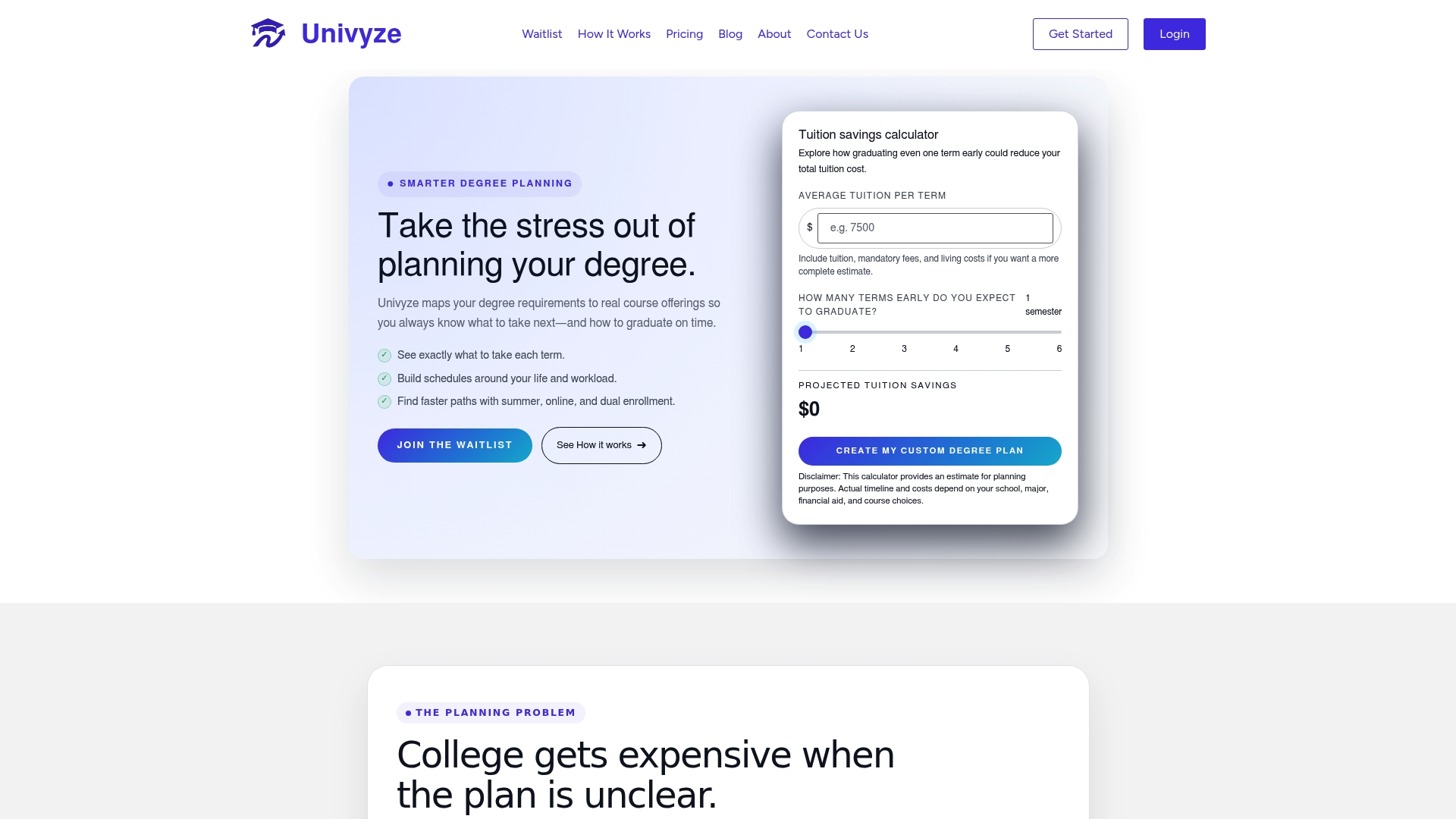
Univyze gives students a dynamic dashboard that maps degree requirements against real course offerings, so you can see exactly which elective credits are included, which are excluded, and which courses fit your plan before you register. The platform connects elective selection to your full degree audit, so nothing falls through the cracks. If you want a clear picture of how to pick classes that actually move you toward graduation, Univyze shows you the path. You can also explore how Univyze works to see how the platform fits your specific degree program.
FAQ
What are electives in a college degree plan?
Electives are courses students choose beyond their required major and general education courses. They typically represent around 25% of a 120-credit bachelor’s degree.
Do all elective credits count toward graduation?
No. Degree audit systems classify electives as included or excluded. Only included elective credits count toward your minimum graduation credit requirement.
How do I know which electives fit my degree audit?
Run a degree audit tool like Degree Works before registering. It shows which credit buckets are open and whether a course will land in an included or excluded slot.
Can electives help my career prospects?
Yes. Transcripts show all completed courses, and career-aligned electives signal cross-functional skills to employers. Research shows 64% of students rank career relevance as the top factor in elective satisfaction.
What happens if I ignore prerequisites for electives?
Ignoring prerequisite chains can block you from enrolling in the elective you want and force last-minute substitutions. In the worst case, it delays graduation by a full semester or more.